Superhydrophilic Polyurethane Coatings

Patent Title: HYDROPHILIC ANTI-FOG COATINGS

 Number/Link: US2015/0344725

Applicant/Assignee: InnoSense

Publication date: 3-12-2015

Gist”: A hydrophilic anti-fog coating is pepared by incorporating silica particles  and organosilicate micelles

Why it is interesting: A superhydrophilic coating composition is made from a polyurethane prepolymer together with 1-5% (w/w) of a ~30nm monodisperse colloidal silica and up to 10% (v/v) of organosilicate micelles having a hydrophilic porous ‘shell’ and a (pref.) hydrophilic ‘core’, all in a solvent. The composition is said to be especially useful for anti-fog coatings on optically-clear plastic substrates (polycarbonate, polyurethane, polyester..).  According to the theory the porous shell of the micelles draws water away from the coated surface while the micelle cores act as a water reservoir.  Very clever.
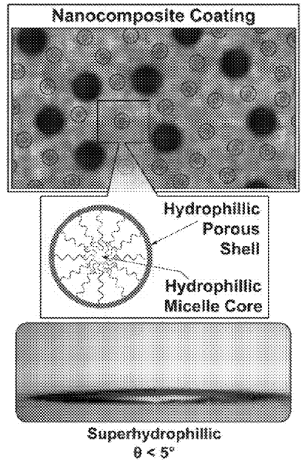
Superhydrophilic coating accordin to the invention

Superhydrophilic coating according to the invention

Melt-Dispersed Polymer Polyols

Title: PROCESS FOR MAKING A POLYMER POLYOL

 Number/Link: WO2015/165761  (German)

Applicant/Assignee: BASF

Publication date: 5-11-2015

Gist”: Polymer polyols are prepared by melt-dispersing SAN into a carrier polyol using a specific stabilizer

Why it is interesting: Polymer polyols, or ‘graft polyols’, contain finely dispersed polymeric particles and are especially useful for the production of flexible polyurethane foams.  Usually polymer polyols are produced by in-situ polymerization of styrene-acrylonitrile (SAN)- or polyurea particles in a carrier polyol. In this invention, polymer polyols are prepared by dispersing molten SAN into a carrier polyol using shear mixing and a specific stabilizer.  The stabilizer is a (preferably) comb-shaped polyol-SAN copolymer, and is described in another BASF application: WO2015/165878. The polymer polyols are said to have a fine and uniform particle size distribution, a low viscosity and a high stability against segregation.

SAN

SAN

Flexible Foams with Improved Thermal Comfort

Title: IN-SITU GELATINOUS TRIBLOCK COPOLYMER ELASTOMERS IN POLYURETHANE FLEXIBLE FOAMS

 Number/Link:US2015/0166756

Applicant/Assignee: Peterson Chemical Technology

Publication date: 18-06-2015

Gist”: Gelatinous styrenic block copolymers are incorporated in flexible foams to increase thermal conductivity.

Why it is interesting: High viscosity styrenic triblock copolymer resins (like SBS, SEBS, SIS etc), plasticized with mineral oils, are added to flexible foam-forming compositions. The heat of the foam-forming reaction is said to be sufficient to further polymerize the resins and melt the styrene-block such that the block copolymers get integrated into the polyurethane matrix. The resulting foams show increased load bearing and improved thermal conductivity. These systems could improve the thermal comfort properties of cushioning materials, especially those of viscoelastic foams.

Poly(styrene-butadiene-styrene) or SBS.

Poly(styrene-butadiene-styrene) or SBS.

  • Pages

  • Categories

  • Enter your email address to follow this blog and receive notifications of new posts by email.

    Join 259 other subscribers
  • Follow Innovation in PU on Twitter