Green Tea Memory Foam

Patent Title: Foam with Green Tea Additive for Foam Mattresses, Pillows and Cushions

 Number/Link: US2016/0270549

Applicant/Assignee: Zinus

Publication date: 22-09-2016

Gist”: Green Tea is added to memory foam formulation

Why it is interesting: Powdered leaves of the Green Tea plant (Camellia sinensis) are added to memory foam formulations in an amount of less than 2% (w/w) on the total composition.  The Green Tea is said to kill bacteria, mites and molds and reduce the smell of the foam when used in pillows and mattresses for example. Since tea leaves are also claimed to “brighten eyesight, refresh the brain and resist radiation” it’s hard to know if the claim is true. If it doesn’t work it won’t hurt I guess.

Cammelia sinensis (Wikipedia)

Camellia sinensis (Wikipedia)


Novel Cellopener for Flexible- and Viscoelastic PU Foams

Patent Title: POLYURETHANE FOAM WITH AQUEOUS POLYMER DISPERSION  & VISCOELASTIC POLYURETHANE FOAM WITH AQUEOUS POLYMER DISPERSION

 Number/Link: WO2016/100306 & WO2016/100263

Applicant/Assignee: Dow

Publication date: 23-06-2016

Gist”: Dispersions of acid modified olefins in water act as cellopeners

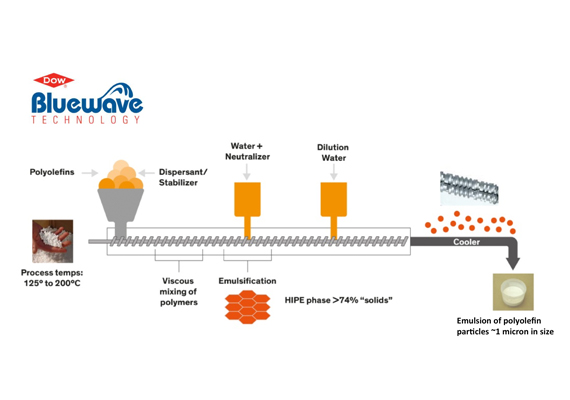
Why it is interesting: According to this invention aqueous dispersions of acid-modified olefins can be used as cellopeners for conventional, high resilience and viscoelastic foams. The examples show that a 40% ‘solids’ dispersion of an acrylic acid – ethylene copolymer in water, used in about 1 to 2% on the total isocyanate-reactive composition has a clearly positive effect on foam air-flow properties. The polymer dispersions can be made according to Dow’s proprietary BLUEWAVE™ extrusion technology.

The BLUEWAVE dispersion process

The BLUEWAVE dispersion process


Novel Polyurethane Gels

Patent Title: POLYURETHANE BASED GEL COMPOSITION

 Number/Link: W016/036786

Applicant/Assignee: Dow

Publication date: 10-03-2016

Gist”: PU gels are made from MDI prepolymer, high EO polyol and some diamine at low NCO index.

Why it is interesting: Polyurethane gels are well known and are sometimes used in comfort cushioning as layers or dispersed as particles in e.g. viscoelastic matresses. According to this invention plasticizer-free gels can be made by reacting a slightly branched, low NCO prepolymer ( based on 2,4′ and 4,4′ MDI and a high EO polyol), with a large amount of high EO polyol (triol or higher) and some amine-ended low mole-weight diol.
Although the material is said to be ‘plasticizer-free’not all of the polyol will be reacted at low NCO index.  However, because of its high polarity, the unreacted polyol will probably not leach.

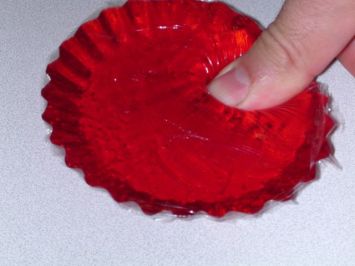
A Polyurethane Gel

A Polyurethane Gel

  • Pages

  • Categories

  • Enter your email address to follow this blog and receive notifications of new posts by email.

    Join 259 other subscribers
  • Follow Innovation in PU on Twitter