Thermoplastic Polyurethane with a Percisely Controlled Biodegradation Rate

Title: PROCESS FOR MAKING BIODEGRADABLE AND/OR BIOABSORBABLE POLYMERS

 Number/Link: WO2014/004334

Applicant/Assignee: Lubrizol

Publication date: 03-01-2014

Gist”: Two sets of parameters are given (and claimed) which, when iteratively adjusted, allow to independently modify the mechanical properties and biodegradation rate of a TPU.

Why it is interesting: Many biomedical materials for implants such as screws, bone plates, tissue scaffolds, pins etc need high mechanical properties but also a controlled biodegradation rate which can vary from weeks to years.  According to this case the precise control of the degradation rate is not possible with currently available bio-polymers.  The invention claims two sets of parameters one which controls the physical properties of a TPU like the molecular weight, harblock content, crystallinity etc, and another set which controls the biodegradation rate like the amount of ‘hydrolyzable units’ in the backbone, hydrophilicity ect. It is claimed that both mechanical properties and degradation rate can be independently controlled by adjusting one or more parameters of each set. In the examples TPUs are prepared from HMDI, 1,4-butane diol and poly(lactide-co-caprolactone) diols where the lactide is the hydrolyzable unit.

A poly(lactide-co-caprolactone)

A poly(lactide-co-caprolactone)

Very Tough Polyurethane Elastomers Based on a Novel Type of Polyester Polyol

Title: POLYESTER POLYOL FOR USE IN POLYURETHANE

 Number/Link: WO2013/156450

Applicant/Assignee: Purac Biochem

Publication date: 24-10-2013

Gist”: Tough polyurethane elastomers can be prepared from polyester polyols based on dimer acid and lactide oligomers.

Why it is interesting: The invention claims a new type of ABA polyester polyol where A is a hydrophilic lactide oligomer and B is a hydrophobic dimer diacid initiator. The lactide ologimers can be produced by ring-opening polymerization of cyclic lactide and preferably contain between 4 and 16 lactoyl units.  The dimer diacid is prepared by dimerizing unsaturated C12 to C22 fatty acids, preferably linoleic or linolenic acid. The molecular weight of the polyester polyol is preferably between 1000 and 3500 dalton. Solid polyurethane elastomers prepared from this type of polyols reportedly have much improved toughness and other mechanical properties.

Example of a Dimer Acid

Example of a Dimer Acid

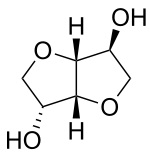
Polyurethane Prepregs prepared with Isosorbide

Title: STORAGE-STABLE POLYURETHANE-PREPREGS AND FIBRE COMPOSITE COMPONENTS PRODUCED THEREFROM

 Number/Link: WO2013/139704

Applicant/Assignee: Bayer

Publication date: 26-09-2013

Gist”: Polyurethane matrix materials for prepregs with very good storage stability are prepared from an NCO prepolymer together with isosorbide and delayed action catalysts.

Why it is interesting: Resins for “prepregs” (pre-impregnated fibre composites) need to have a low viscosity upon impregnation, a good storage stability and a fast ‘curing’ reaction preferably at a relatively low temperature.  According to this invention all these properties can be met by using a 8-16% NCO prepolymer made from a polyester polyol and  MDI, together with a dianhydrohexitol (preferably isosorbide) as chain extender and a delayed action catalyst (e.g. a blocked amine) which is activated between 50 and 100°C. The resulting prepregs have a storage stability at room temperature of several weeks. Final Tg is said to be 130°C, which is not very high but should suffice for many applications.

Isosorbide

Isosorbide

  • Pages

  • Categories

  • Enter your email address to follow this blog and receive notifications of new posts by email.

    Join 259 other subscribers
  • Follow Innovation in PU on Twitter