High Resiliency Polyurethane Foams

Title: HIGH RESILIENCY POLYURETHANE FOAMS MADE WITH HIGH FUNCTIONALITY, HIGH EQUIVALENT WEIGHT POLYOLS WITH MAINLY SECONDARY HYDROXYL GROUPS

Number/Link: WO2017/062150

Applicant/Assignee: Dow

Publication Date: 13 April 2017

“Gist”: Use of high functionality polyols increases the resilience of flex foams

Why it is interesting:  According to this invention the resilience of flexible PU foams can be increased by using, as part of the polyol composition, a random EO/PO polyether polyol which has an equivalent weight of at least 1500, a functionality of  at least 5, a secondary hydroxyl group content of at least 70%, an unsaturation value of at most 0.01 meq/g and an EO content between 5 and 30%.  In the examples, sorbitol initiated polyols are used in both MDI and TDI-based systems, resulting in ball rebound values of up to 60% at densities of about 30 kg/m³.  As I have shown in the past (US5521226) the same (or arguably an even stronger) effect on resilience can be obtained with other high functionality polyols, indicating that the unsaturation value, primary OH content, EO content and equivalent weight are probably not relevant to the resilience increase.
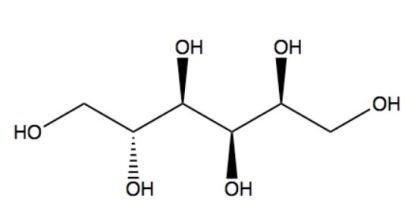
Sorbitol

Classic PU Patent of the Month: ICI’s Perfect Elastomer (1995)

Patent Title: POLYURETHANE ELASTOMERS

 Number/Link: WO 97/21750

Applicant/Assignee: ICI

Publication date: 19-06-1997

Gist”: A polar polyether softblock and highly symmertrical hardblock results in a near-perfect polymer morphology.

Why it is interesting: ICI’s “perfect PU elastomer” is accomplished by reacting a polar, low-reactive polyether triol (75% EO random, 42 OHv) and a ‘stacking’ chain extender (MEG) with a symmetrical diisocyanate (4,4′ MDI).  Some water can be added to a density of about 400 kg/m³. This combination results in a remarkable polymer morphology with a ‘nano’ phase-separated hard domain and a very ‘clean’ soft phase, resulting in a very high (>1) and symmetrical damping peak (tan δ) and an incredibly flat storage modulus (E’) up to about 200°C.  Damping at positive temperatures  is virtually zero, resulting in a very high resilience.  The patent actually claims the shape of the DMTA trace rather than the composition of the polymer.
The elastomer is not completely “perfect” in that it has relatively low mechanical properties, such that it is perferably used in a structural- or fiber/particle reinforced composite.

1Hz DMTA trace of ICI's "perfect elastomer".

1Hz DMTA trace of ICI’s “perfect elastomer”.

  • Pages

  • Categories

  • Enter your email address to follow this blog and receive notifications of new posts by email.

    Join 259 other subscribers
  • Follow Innovation in PU on Twitter