Can NOPs Rejuvenate Hot Cure Moulding?

Title: POLYOLS SUITABLE FOR HOT MOLDED FOAM PRODUCTION WITH HIGH RENEWABLE RESOURCE CONTENT

 Number/Link: US2013/210951

Applicant/Assignee: Bayer

Publication date: 15-08-2013 (priority PCT)

Gist”: Castor oil based polyols designed for hot cure flexible foam allow for higher renewable content.

Why it is interesting: In the recent years there has been a growing use of renewable-resource based polyols in flexible foam production. However, because the current moulded flexible foam industry is dominated by the so-called “cold cure” process which typically needs highly reactive polyols, the maximum amount of renewables is usually limited to about 10% of the polyol. Bayer have now developed a natural oil based polyol specifically for hot cure moulding. The polyol of the invention is based on castor oil, EO, PO and a DMC catalyst such that the total amount of EO is 20 to 30% and the total amount of primary OH is between 35-45%.  When used in a hot cure moulding process the polyol allows for at least 30% (on the polyol) of renewables with foams having properties similar to conventional hot cure foams.

Major Component of Castor Oil

Major Component of Castor Oil

Improved Viscoelastic Flexible Foams (“Memory Foams”)

Title: USE OF POLY(BUTYLENE OXIDE) POLYOL TO IMPROVE DURABILITY OF MDI-POLYURETHANE FOAMS

Patent Number & Link:  US2013178548    (related case US2013178550 )   

Applicant/Assignee: Dow

Publication date: 11-07-2013 (priority PCT/US)

Gist”: Use of a high molecular weight butyleneoxide monol to improve the compression set of viscoelastic foams.

Why it is interesting: Viscoelastic or “memory” flexible foams are currently popular for use in matresses and pillows. Much research and development has been done on these materials and the patent situation is a true minefield. Usually a mixture of EO-rich and PO-rich polyols of different molecular weights is used to control the glass transition temperature (Tg) of the softblock, wich in turn controls the energy absorption (and thus the resilience) of the foam. In this invention a butyleneoxide monol of high MW is used in addition to a mixture of EO-rich and PO-rich polyols. The BO-monol is used in an amount of 2-10% on the polyol  and supposedly improves compression set while retaining the open cell character (air flow) of the foam.
The related case (US2013/178550) is similar but uses a high MW PO polyol with a functionality between 1 and 4 instead of the BO monol.  It is not immediately clear to me whether this latter case is a real invention or is just plugging a hole in the minefield..

A viscoelastic flexible foam

A viscoelastic flexible foam

Polymer Polyols with Phosphorous-Containing Particles

Title: PHOSPHOROUS BASED POLYADDITION/POLYURETHANE-UREA POLYOLS

 Patent Number & Link: WO2013101524

Applicant/Assignee: Dow

Publication date: 4-07-2013

Gist”: PHD and PIPA polyols are produced in the presence of phosphorous containing polyols

Why it is interesting: PDH or PIPA polymer polyols can be prepared by dissolving a low MW amine- or  hydroxyl containing co-reactant in a ‘base polyol’ and subsequently reacting with an isocyanate. When executed properly and with the correct ingredients this results in a stable dispersion of respectively urea or urethane particles in the base polyol. (see also previous posts in this blog). This invention states that by using phosphorous flame retardants containing amine or hydroxyl groups in addition to the co-reactant, PIPA or PHD (or hybrid) polymer polyols can be prepared with flame the retardant incorporated in the particles, resulting in a flame retardant polymer polyol.

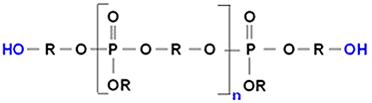
Phosphorous polyol as used in the invention

Phosphorous polyol as used in the invention

  • Pages

  • Categories

  • Enter your email address to follow this blog and receive notifications of new posts by email.

    Join 259 other subscribers
  • Follow Innovation in PU on Twitter