PIPA Polyol Made From “Conventional” Polyol

Title: PROCESS FOR THE PREPARATION OF A POLYOL COMPOSITION

 Number/Link: WO2014/037558

Applicant/Assignee: SHELL

Publication date: 13-03-2014

Gist”: A PIPA polyol is made from TDI,  TELA and a high sec-OH polyol which is added in two stages.

Why it is interesting: PIPA polyols are a class of ‘filled’ polyols containing dispersed polyurethane particles and are often used in flexible foams to improve hardness and air flow. These polyols are usually produced by dispersing an olamine, like triethanolamine (TELA), in an EO-tipped EO/PO polyether polyol and reacting it with isocyanate under mixing.  Producing PIPA polyols from a high secondary-OH containing (“conventional”) polyol, i.e. an all- PO or EO/PO random polyol would have cost advantages but -according to SHELL- results in an unstable polyol which produces closed-celled flexible foam. The trick they invented to solve this problem is to produce the particle dispersion from TELA and TDI in about 50% of the total amount of polyol used and adding the remainder of the polyol in a second step.  Remarkably this simple trick appears to be new and patentable.
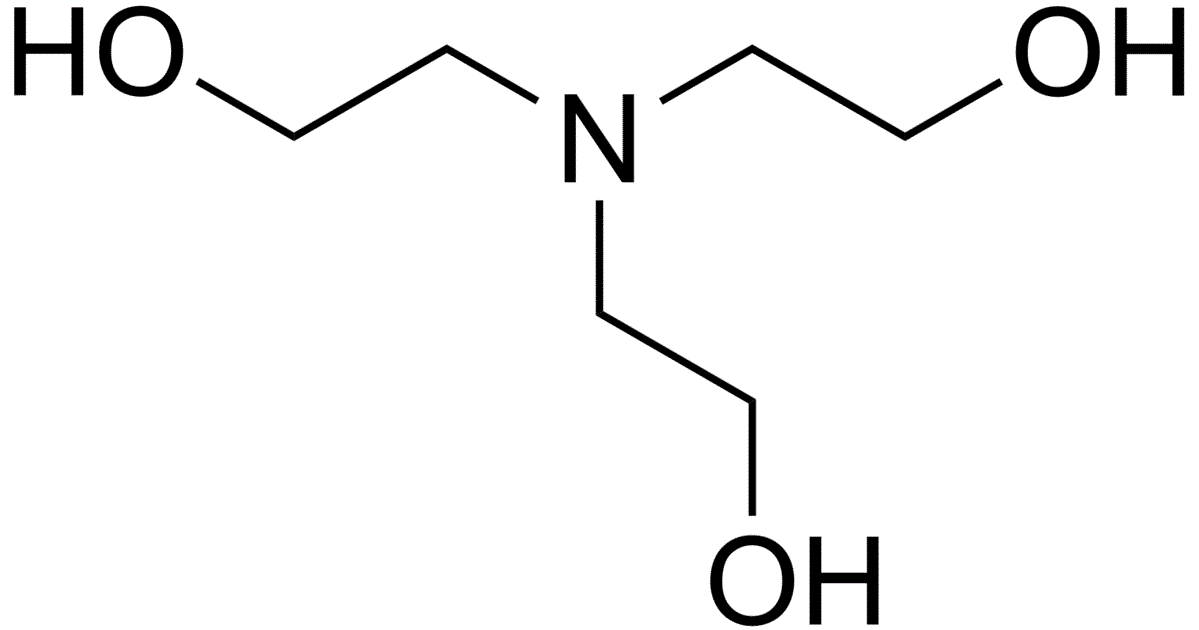
Triethanolamine
Triethanolamine

Water Soluble Polyurethane “Star Polymers”

Title: MULTI-ARM HYDROPHILIC URETHANE POLYMERS, METHODS OF MAKING THEM, AND COMPOSITIONS AND PROCESSES EMPLOYING THEM

 Number/Link: US2014/038874

Applicant/Assignee: Stepan

Publication date: 6-02-2014

Gist”: PU star polymers, useful as surfactants, are prepared from a polyhydroxy ‘core’ molecule, a diisocyanate and a surplus of PEG.

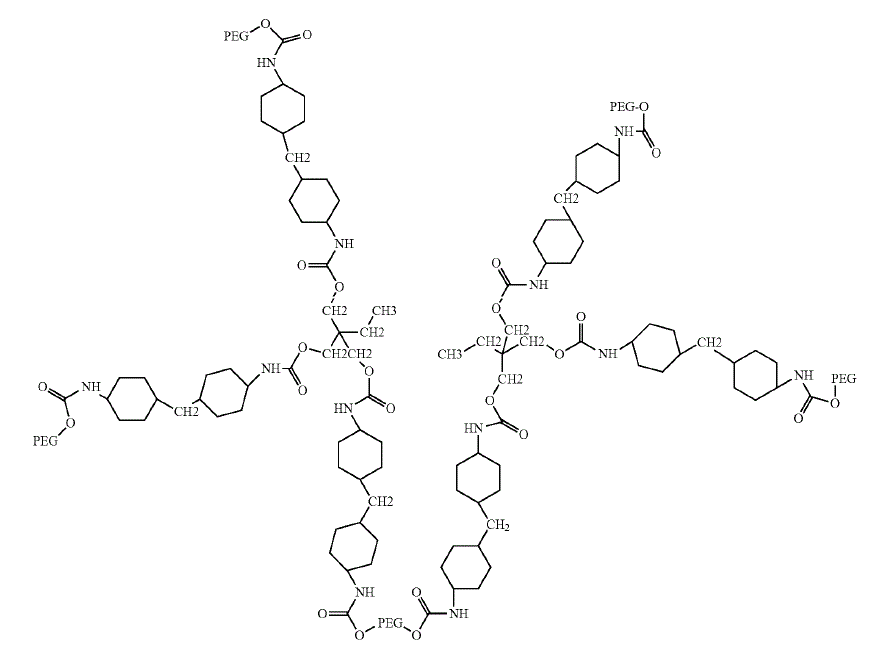
Why it is interesting: A low MW ‘core’ molecule with an OH functionality of up to 6 is reacted with a surplus of diisocyanate to form an NCO ended prepolymer. The prepolymer is then reacted with a suplus of a polyethylene glycol (PEG).  Reactants and ratios are chosen such that the average MW of the resulting product is less than about 10,000 and is water soluble or at least water dispersible. In an example trimethylolpropane is reacted with dicyclohexylmethane di-isocyanate (H12MDI) and ‘capped’ with PEG 400,  resulting in a mixture of structures, one of which is shown below.  The star polymers are supposedly useful as surfactants for use in detergents etc..
While these are interesting molecules, I doubt that these stuctures can be controlled finely enough to compete with established surfactants. I might be more interesting to use methoxy PEGs (i.e. monols) instead of PEGs.

Example of a PU star polymer.

Example of a PU star polymer.

Polyurea ‘Nano’-Particles to Improve Properties of Polyurethane Flexible Foams and Elastomers

Title: USE OF POLYUREA NANOPARTICLES AS PERFORMANCE MODIFIERS IN POLYURETHANE MATERIALS

 Number/Link: WO2014/012769

Applicant/Assignee: Huntsman

Publication date: 23-01-2014

Gist”: A dispersion of polyurea particles prepared from 4,4′ MDI, diamine chain extender and a high mole weight monoamine is used to improve mechanical properties of flex foam.

Why it is interesting: Dispersions of polyurea particles with an average diameter of a few hundred nanometer and a Tg>150°C (pref.) can be produced by first reacting a relatively high MW polyether monoamine and a di-isocyanate (optionally dispersed in e.g. polyol) and subsequently adding a diamine chain extender. The dispersion is then used in a flexible foam or elastomer formulation, such that the amount of particles in the material is about 1-5% (w/w). In an example a 2000MW EO/PO monoamine was used together with 4,4′-MDI and a diamine chain extender to produce a particle dispersion in polyol, which was then used in polyurethane formulations. The particles do seem to have a positive effect on mechanical properties, however, the results for flex foam are clouded because of a sharp increase in material density compared to the reference. This density increase may well be due to a cellopening effect as described in WO2007/104623  in which a similar particle dispersion is used.

Polyethermonoamine as used in the invention.

Polyethermonoamine as used in the invention.

  • Pages

  • Categories

  • Enter your email address to follow this blog and receive notifications of new posts by email.

    Join 259 other subscribers
  • Follow Innovation in PU on Twitter