Classic PU Patent of the Month: Non-Isocyanate Polyhydroxyurethanes by Dow (1957)

Title: Polyhydroxyurethanes

 Number/Link: US3084140

Applicant/Assignee: Dow

Publication date: 2-04-1963

Gist”: bis-cyclocarbonates are reacted with aliphatic polyamines

Why it is interesting: Non-isocyanate polyurethanes (NIPU) are still gaining in popularity – at least in the patent and science literature. The chemistries to make NIPU are far from new as discussed in a previous ‘classic patent of the month’ on this blog.  The most common route to NIPU is by reacting cyclocarbonates with amines resulting in hydroxyurethanes, as was first dicussed in this patent. The intent of the invention was, actually, not to avoid the use of isocyanates but to make hydroxy-group containing polyurethanes which were said to be ‘highly desirable’:  the OH groups can act as points for crosslinking, make the resin more hydrophilic and compatible with certain materials etc.

Preparation of polyhydroxyurethanes according to the invention
Preparation of polyhydroxyurethanes according to the invention

Classic PU patent of the Month: PORON ® Foams (1979)

Title: Polyurethane foam product and process of manufacture thereof from thermosetting frothed mixture

 Number/Link: US4216177

Applicant/Assignee: Rogers

Publication date: 5-08-1980

Gist”: Frothed flexible foam

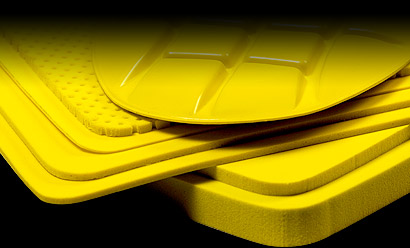
Why it is interesting: PORON is a popular brand of microcellular elastomeric/flexible polyurethane foams produced by Rogers Corporation. The original process, as documented in this patent, is quite simple:  a flexible foam formulation (in the examples) based on TDI, caprolacton diol, polymer polyol, some chain extender, amine catalyst and surfactant is frothed instead of blown with water or a physical blowing agent. The reacting froth is poured on release paper and heated to cure. Release paper can also be applied on top resulting in an integral skin on both sides of the layer. Frothing instead of blowing results in an improved compression set, different hardness-density relationship and a better control over cell structure. A unique material.

PORON foams

PORON foams

Classic PU Patent of the Month: Bayer on Viscoelastic Flexible Foams (1988)

Title: Process for the preparation of cold-hardening flexible polyurethane foams having excellent deadening properties.

 Number/Link: EP0331941

Applicant/Assignee: Bayer

Publication date: 13-09-1989

Gist”: Highly damping flexible foams are made using a mixture of three specific polyols.

Why it is interesting: “Visco” or “memory” foams are currently known especially for their use in matresses and pillows.  Originally however these “dead” foams were developed as vibration damping materials for acoustic applications. The invention is based on the use of three specific polyols: (a) a ‘normal’ PO/EO-tipped triol with a hydroxyl value of about 28, (b) a ‘rigid’ all-PO triol with OHv of about 350 and (c) a ‘high EO’ triol with an EO content of about 75% and OHv of 36. The polyols are used in a ratio of about 25:15:60 (a:b:c) together with either TDI or MDI. Because the polyols are relatively immiscible the resulting foams have a soft-phase glass transition which is ‘smeared’ out over a temperature range controlled by polyol (a) at the low end and by (c) at the high end – ranging e.g. from -30°C to +10°C. This wide glass transition in turn results in a very wide damping frequency range.  A very clever idea that has been copied many times.

Polyurethane "memory foam"

Polyurethane “memory foam”

  • Pages

  • Categories

  • Enter your email address to follow this blog and receive notifications of new posts by email.

    Join 259 other subscribers
  • Follow Innovation in PU on Twitter