TPU for 3D Printing

Title: METHODS OF USING THERMOPLASTIC POLYURETHANES IN FUSED DEPOSITION MODELING AND SYSTEMS AND ARTICLES THEREOF .

 Number/Link: WO2015/109141

Applicant/Assignee: Lubrizol

Publication date: 23-07-2015

Gist”: TPU with specific crystallization temperature and modulus retention can be used for fused deposition modeling

Why it is interesting: Additive manufacturing in all its forms has been a steadily growing trend over the last few years.  Many different materials have been used in these processes, but the use of thermoplastic polyurethane has proven to be difficult because of its low crystallization rate, broad melting range and challenging melt-viscosity control.  According to this application TPU can be used for fused deposition modeling (“3D printing” by extruding molten thermoplastics) when it has a crystallization temperature of about 115°C and retains its shear modulus well with temperature.  Examples of such TPUs have a high harblock content (about 50%) and a molar ratio of chain extender to polyol of 2 to about 4,  and are prepared from 4,4′-MDI, butandiol and 2000 MW PTMEG polyether or butylene-adipate polyester diols.

Fused Deposition Modeling
Fused Deposition Modeling

PU Rigid Foams from Biomass Proteins

Title: POLYOLS FROM BIOMASS AND POLYMERIC PRODUCTS PRODUCED THEREFROM

 Number/Link:WO2015/105542

Applicant/Assignee:  Inventors

Publication date: 16-07-2015

Gist”: Soy bean proteins are hydrolysed and reacted with diamines and cylocarbonates to produce “rigid” polyols.

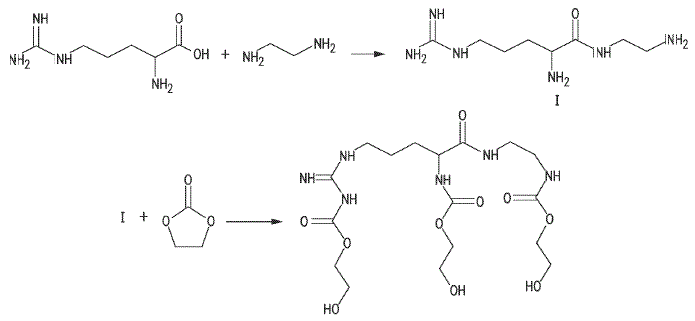
Why it is interesting: During recent years a lot of research has been done on the use of renewable raw materials in polyurethanes.  Most of this research was on the use of natural oils despite the fact that the availability of biomass proteins is much higher. Soybeans for example contain about twice as much protein (about 38% w/w) than oil (18%) and the price is about half that of the oil. According to this invention soybean proteins are hydrolysed into amino acids which are then reacted with ethylene diamine to make amine-ended monomers.  These monomers are reacted with a cyclocarbonate (ethylene carbonate or glycerol carbonate) resulting in a mixture of hydroxyurethane oligomers. The mixture is a low viscous liquid with high hydroxyl value useful for the production of rigid foams.

Reaction sequence according to the invention

Reaction sequence according to the invention

Triptycene Chain Extenders

Title: TRIPTYCENE MONOMER AND TRIPTYCENE CONTAINING POLYESTERS AND POLYURETHANES

 Number/Link: US20150191408

Applicant/Assignee: not yet recorded. Research supported by US Army

Publication date: 9-07-2015

Gist”: A novel primary diol derived from triptycene is useful as chain extender for polyurethanes and polyesters.

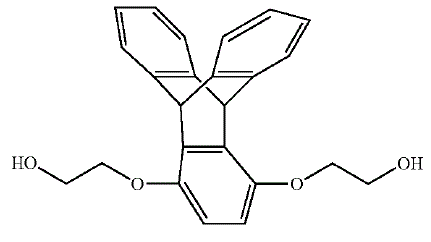
Why it is interesting: Polymers with increased mechanical properties and stiffness can be obtained by incorporating rigid structures in the polymer chain.  This however also results in increased glass transition temperature and reduced ductility because of reduced chain flexiblity and entanglements.  According to this invention polyurethanes (and copolyesters) with high modulus and good ductility at low temperatures can obtained by using triptycene-1,4-hydroquinone-bis(2-hydroxyethyl ether) or TD. In and example TD capped with PEG400 is reacted with a 4,4’MDI- PTMEG1000 prepolymer.  The resulting material indeed has a very low softblock Tg of  -65ºC and a much higher Y modulus compared to a PU made with HQEE as chain extender. According to the inventors the PU is highly suitable as a matrix material in KEVLAR or UHMWPE fiber composites.
In my opinion this is a very interesting chain extender as it appears to prevent H-bond formation and increase molar volume thereby substantially decreasing Tg. However lack of availability, and (most probably) price, will prevent this from becoming mainstream anytime soon.

Tryptycene-1,4-hydroquinone-bis(2-hydroxyethyl ether)

Triptycene-1,4-hydroquinone-bis(2-hydroxyethyl ether)


  • Pages

  • Categories

  • Enter your email address to follow this blog and receive notifications of new posts by email.

    Join 259 other subscribers