Modified Polyols for Improved PU Adhesives

Title: POLYOL COMPOSITIONS FOR HOT MELT ADHESIVES

 Number/Link:WO2015/127276

Applicant/Assignee: IFS Industries

Publication date: 27-08-2015

Gist”: Polyester diols are partially capped with bulky glycidyl esters

Why it is interesting: According to this invention polyester (or polyether) polyols which are partially capped with a bulky glycidyl ester can be used to improve the adhesive properties of (reactive) polyurethane (hotmelt) adhesives. Specifically the adhesion to materials with low surface energies like ABS or polyolefines is said to improve. In the examples polyester diols prepared from adipic acid and hexanediol with a Mn of about 3000 are partially capped with the glycidyl ester of neodecanoic acid (“Versatic Acid 10”) and used in PU adhesive formulations.
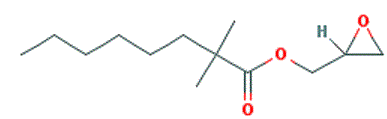
Glycidyl ester of neodecanoic acid

Glycidyl ester of neodecanoic acid

TPU for 3D Printing

Title: METHODS OF USING THERMOPLASTIC POLYURETHANES IN FUSED DEPOSITION MODELING AND SYSTEMS AND ARTICLES THEREOF .

 Number/Link: WO2015/109141

Applicant/Assignee: Lubrizol

Publication date: 23-07-2015

Gist”: TPU with specific crystallization temperature and modulus retention can be used for fused deposition modeling

Why it is interesting: Additive manufacturing in all its forms has been a steadily growing trend over the last few years.  Many different materials have been used in these processes, but the use of thermoplastic polyurethane has proven to be difficult because of its low crystallization rate, broad melting range and challenging melt-viscosity control.  According to this application TPU can be used for fused deposition modeling (“3D printing” by extruding molten thermoplastics) when it has a crystallization temperature of about 115°C and retains its shear modulus well with temperature.  Examples of such TPUs have a high harblock content (about 50%) and a molar ratio of chain extender to polyol of 2 to about 4,  and are prepared from 4,4′-MDI, butandiol and 2000 MW PTMEG polyether or butylene-adipate polyester diols.

Fused Deposition Modeling

Fused Deposition Modeling

TPU from Three Types of Polyol and TODI

Title: THERMOPLASTIC POLYURETHANE FOR SEAL APPLICATIONS

 Number/Link:WO2015/090916 (German)

Applicant/Assignee: Carl Freudenberg

Publication date: 25-06-2015

Gist”: TPU based on blend of a polyester- polyether- and polycarbonate diols has exceptional properties

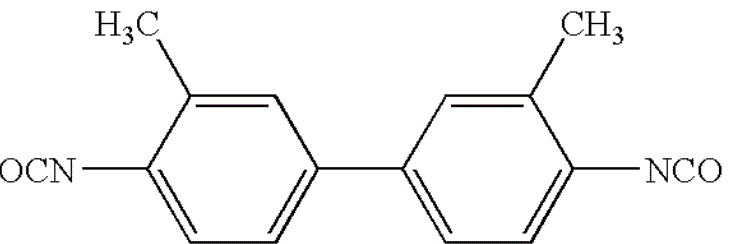
Why it is interesting: According to this application, TPUs prepared from blends of polyether, polyester and polycarbonate diols, result in materials with very high hydrolysis resistance, mechanical properties, high- ánd low temperature resistance and with excellent processing properties. In the examples 2000 MW polyether-, polycarbonate- and polycaprolactone diols are blended, reacted with toluidinediisocyanate (TODI) and subsequently extended with butanediol.  Surprisingly there appears to act some kind of synergy resulting in properties higher than would be expected from the individual polyol components.

3,3'-Dimethyl-4,4'-Biphenyldiisocyanate (TODI)

3,3′-Dimethyl-4,4′-Biphenyldiisocyanate (TODI)

  • Pages

  • Categories

  • Enter your email address to follow this blog and receive notifications of new posts by email.

    Join 259 other subscribers
  • Follow Innovation in PU on Twitter