Renewable Polyurea from Lysinol

Title: NEW POLYMERS DERIVED FROM RENEWABLY RESOURCED LYSINOL

 Number/Link: US2014/275311

Applicant/Assignee: Du Pont

Publication date: 18-09-2014

Gist”: Use of lysinol as renewable monomer for nitrogen-containing polymers including polyurea.

Why it is interesting: Lysinol or 2,5-diamino-1-hexanol is an amino alcohol derived from the amino acid lysine by  hydrogenation.  Lysine itself is produced by fermentation from sugars.  Annual production of lysine is apparently in excess of 1 million tonnes and its derivative lysinol is therefore considered as a potentially interesting biorenenawable monomer for a number of nitrogen-containing polymers. This patent application claims lysinol-based polyamides, polyimides, polyureas and “urethane crosslinked” polyureas including foams. In the examples urethane-polyureas are produced by reacting lysinol with hexamethylenediisocyanate using DABCO as catalyst.

Preparation of the two lysionol enantiomers from lysine.

Preparation of the two lysinol enantiomers from lysine.
Bio-Renewable Thermoplastic Polyurethanes

Title: HOMOGENEOUS EXTRUDED ARTICLES MADE FROM THERMOPLASTICALLY PROCESSABLE POLYURETHANES BASED ON POLYESTER DIOLS FORMED FROM SUCCINIC ACID AND 1,3-PROPANEDIOL

 Number/Link: US2014/0256902

Applicant/Assignee: Bayer

Publication date: 11-09-2014 (priority PCT)

Gist”: TPU based on polyester diols prepared from succinic acid and propandiol

Why it is interesting: The use of biorenewable raw materials is no longer a curiosity in polyurethane production. Especially natural oil-based polyols are currently fashionable in newly developed products.  These ‘NOPs’ are however not very suitable for the production of thermoplastic polyurethanes.  According to the current invention (partly) bio-renewable TPUs can be produced from polyester diols based on succinic acid and 1,3-propanediol. Both these monomers can be produced by fermentation of carbohydrates. 1,3-propanediol is produced on industrial scale by DuPont through fermentation of corn syrup using genetically modified E.Coli bacteria (“Bio-PDO”). In the examples PDO-succinate polyester diols with MW from 1000 to 2000 are used together with 4,4′-MDI and 1,4-butanediol to produce TPUs with shore hardness ranging from 85 to 94A and Tg’s from -18 to +11°C.

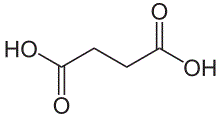
Succinic acid or butanedioic acid.

Succinic acid or butanedioic acid.

Renewable Polyols from “Distillers Grains”

Title: PRODUCTION OF POLYOLS USING DISTILLERS GRAINS AND PROTEINS AND LIGNIN EXTRACTED FROM DISTILLERS GRAINS

 Number/Link: US2014/200324

Applicant/Assignee: EMGPI PROC and PITTSBURG STATE UNIVERSITY 

Publication date: 17-07-2014

Gist”: Dried distillers grains are transamidated and then alkoxylated to form a polyol useful for rigid polyurethane spray foams.

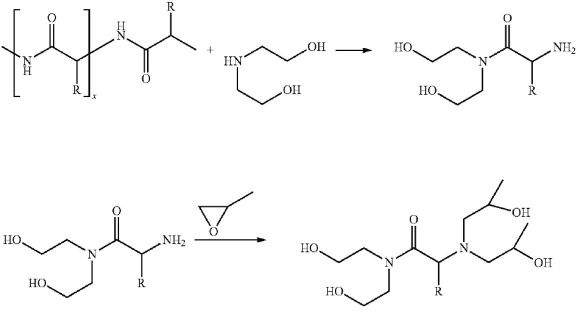
Why it is interesting: ‘Distillers grains’ are a by-product of ethanol production and are currently avaible in huge quatities due to the state-sponsored bio-ethanol production in the US.  Most of the product is used as animal feeds because of the high levels of nutrients. Dried distillers grain (DDGS) contains about 30% protein, about 30% fibers (cellulose, hemicellulose and lignin) and about 30% lipids, ash and water. According to this invention DDGS can be turned into polyols by first reacting the (solid) DDGS with diethanolamine at elevated temperature and pressure (about 200°C and 3.5 MPa) and breaking down the proteins in amino-amides. The resulting liquid can subsequentlly be epoxidized with propylene oxide resulting in a polyol which is supposedly highly reactive and useful for polyurethane rigid spray foams.
Personally I find it hard to believe that a decent reproducible foam can be made with such a horrible mixture.

Transamidation of protein with subsequent epoxidation.

Transamidation of protein with subsequent epoxidation.

  • Pages

  • Categories

  • Enter your email address to follow this blog and receive notifications of new posts by email.

    Join 259 other subscribers
  • Follow Innovation in PU on Twitter