Hydrophobic Coatings from BO Polyols

Title: POLYURETHANE ENCAPSULATE

 Number/Link: WO2014/176390

Applicant/Assignee: Dow

Publication date: 30-10-2014

Gist”: Use of polybutyleneoxide polyols for hydrophobic encapsulants.

Why it is interesting: The encapsulation of water soluble compounds for controlled release, like e.g. plant nutrients and fertilizers, requires a relatively hydrophobic coating.  Often this is accomplished with polyurethane coatings to which hydrophic compounds are added such as castor oil derivatives. These additives can however have a deleterious effect on other coating properties.  According to this invention encapsulation coatings with good mechanical properties and improved water absorption and water vapour transmission properties can be prepared from polybutyleneoxide triols and polymeric MDI without the need for other additives.

Butylene oxide
Butylene oxide

Hydrophobic and Clear Thermoplastic Polyurethane

Title: CLEAR HYDROPHOBIC TPU

 Number/Link: WO2014/121174

Applicant/Assignee: Lubrizol

Publication date: 7-08-2014

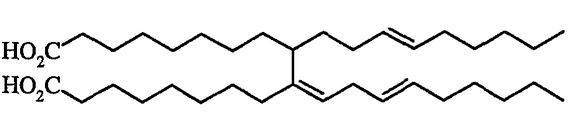
Gist”: A hydrophobic, clear and low density TPU is prepared from 4,4’MDI, a dimer acid-based polyol and a mixture of “non-stacking” chain extenders.

Why it is interesting: Most commercial TPUs are hydrophilic to a certain extend and because of phase separation and partial crystallization are often transparent but not clear. The current invention teaches a highly hydrophobic and clear TPU made form 4,4′ MDI, a polyester polyol produced by reacting a C36 dimerized fatty acid (“dimer acid”) with 1,6-hexanediol and a chain extender mixture consisting of 1,12-dodecanediol and 2-butyl,2-ethyl propanediol or  1,4-cyclohexanedimethanol (all preferred). Hardblock content in the examples is between 25 and about 45% resulting in a shore A hardness range of about 75 to 95. No thermal data are given.
While this is no doubt an interesting material, I expect this to be a single phase glass with a relatively low Tg and therefore less useful for structural applications.

Example of a C36 dimer acid

Example of a C36 dimer acid


Hydrolysis Resistant Polyester Polyurethane

Title: A POLYESTER POLYURETHANE MATERIAL WITH LONG TERM HYDROLYSIS RESISTANCE

 Number/Link: WO2014114614

Applicant/Assignee: Bayer

Publication date: 31-07-2014

Gist”: Hydrolysis resistant polyurethane elastomers can be prepared from sterically hindered polyester polyols together with a perchlorate salt.

Why it is interesting: Because of their high mechanical properties and abrasion resistance, polyester-based polyurethane elastomers are a material of choice in e.g. the footwear and automotive industries. Main drawback however is their susceptibility to hydrolysis which causes loss of physical properties in moist environments.  According to the current invention, hydrolysis resistance can be greatly improved by using a specific polyester polyol together with a perchlorate salt (e.g. 0.3% sodium perchlorate on the total composition). The polyester polyol is based on a diacid (e.g. adipic acid) and a mixture of diols one of which contains alkyl side groups (e.g. a mixture of butanediol and neopentylglycol).
The invention is actually a combination of two known ‘tricks’:  the neopentyl glycol will introduce some hydrophobicity and steric hindrance into the polyester backbone, and the perchlorate may have a weak coordination with the hydrolysable ester bonds thus forming a steric protection layer (at least according to Bayer’s own WO2013/030147). Because both effects are known and published I doubt that this is patentable.

Neopentylglycol

Neopentylglycol

  • Pages

  • Categories

  • Enter your email address to follow this blog and receive notifications of new posts by email.

    Join 259 other subscribers
  • Follow Innovation in PU on Twitter