Polyurethane Tissue Adhesives

Patent Title: URETHANE DECOMPOSING METHOD AND URETHANE DECOMPOSING AGENT

 Number/Link:  US2016/0257800

Applicant/Assignee: Obihiro University

Publication date: 8-09-2016 (priority PCT/JP)

Gist”: Prepolymer from ether-ester polyol and aliphatic isocyanate

Why it is interesting: There is a growing trend in current surgerical practice to replace sutures and staples with adhesives. These tissue adhesives need to have a particular set of properties, like the correct viscosity, hardening speed, biodegradability and toxic and allergenic properties. Current surgical adhesives are often cyanoacrylates, which react very fast, are brittle and show poor biodegradability, or protein-based adhesives which are costly and form weak bonds. According to this invention an improved polyurethane tissue adhesive can be prepared from an isocyanate-ended prepolymer based on an aliphatic isocyanate and a polyol.  The polyol is prepared from a starter polyol or amine which is reacted with a mixture of an alkoxide and about 10-20% of a  lactide (or glycolide or cyclic acid anhydride).  The lactide is randomly copolymerized with the alkoxide using DMC catalysis. The polyol is then reacted with an aliphatic isocyanate, pref. HDI or IPDI in a NCO/OH ratio of about 8:1. After that monomeric isocyanate is removed by thin film distillation down to less than 1% free monomer.
The adhesives are said to be fast, non-toxic, non-allergenic and biodegradable.

L-Lactide

L-Lactide

Classic PU Patent of the Month: ICI’s Perfect Elastomer (1995)

Patent Title: POLYURETHANE ELASTOMERS

 Number/Link: WO 97/21750

Applicant/Assignee: ICI

Publication date: 19-06-1997

Gist”: A polar polyether softblock and highly symmertrical hardblock results in a near-perfect polymer morphology.

Why it is interesting: ICI’s “perfect PU elastomer” is accomplished by reacting a polar, low-reactive polyether triol (75% EO random, 42 OHv) and a ‘stacking’ chain extender (MEG) with a symmetrical diisocyanate (4,4′ MDI).  Some water can be added to a density of about 400 kg/m³. This combination results in a remarkable polymer morphology with a ‘nano’ phase-separated hard domain and a very ‘clean’ soft phase, resulting in a very high (>1) and symmetrical damping peak (tan δ) and an incredibly flat storage modulus (E’) up to about 200°C.  Damping at positive temperatures  is virtually zero, resulting in a very high resilience.  The patent actually claims the shape of the DMTA trace rather than the composition of the polymer.
The elastomer is not completely “perfect” in that it has relatively low mechanical properties, such that it is perferably used in a structural- or fiber/particle reinforced composite.

1Hz DMTA trace of ICI's "perfect elastomer".

1Hz DMTA trace of ICI’s “perfect elastomer”.

Hydrophilic PU Foams from Sulfonated Polyols

Patent Title: HYDROPHILIC OPEN CELL FOAMS

 Number/Link: WO2016/044512

Applicant/Assignee: 3M

Publication date: 24-03-2016

Gist”: Use of sulfonated polyols to make hydrophilic foams

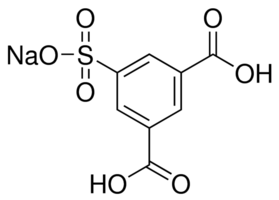
Why it is interesting: Hydrophilic polyurethane foams are well known and often made using polyols with a high ethyleneoxide content.  According to this invention, open celled, hydrophilic foams can be made using a polyol blend containing polyols (or polyamines) having charged functional groups. In the examples a polymeric MDI is reacted with a polyol blend of a 3000MW, 8% EO, triol with up to 40% (w/w) of a sulfonated diol. The sulfonated diol is prepared by reacting 0.25 moles of  dimethyl sodium 5-sulfoisophthalate with 1 mole of PEG 600. The foams have properties useful for use as household sponges.

Dimethyl sodium 5-sulfoisophthalate

Dimethyl sodium 5-sulfoisophthalate

  • Pages

  • Categories

  • Enter your email address to follow this blog and receive notifications of new posts by email.

    Join 259 other subscribers
  • Follow Innovation in PU on Twitter