TPU with Anti-Biofouling Surface

Patent Title: ANTIFOULING COMPOSITION

 Number/Link: WO2017/007899

Applicant/Assignee: BASF

Publication date: 12-jan-2017

Gist”: TPU containing silicone diol and having microstructured surface

Why it is interesting: Biofouling of surfaces e.g. in the marine environment or of medical implants is a problem.  For example the growth of barnacles on the hulls of vessels, subsea cables, pipes and energy generating structures has a significant economic impact. According to this invention, thermoplastic polyurethane articles with a surface energy of about 20 mN/m and a microstructered surface topography show an improved resistance to biofouling. The TPU is produced by incorporating 5-15% on the total composition of a PDMS diol with a OH value of 15 to 150, and by pressing onto the surface a 3D topology with ‘peaks’ and ‘valleys’ of an order of magnitude of 10μm.

Microstructured surface according to the invention
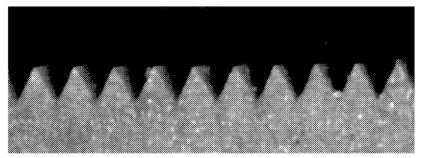
Microstructured surface according to the invention

TPU/PU-Acrylate Semi-IPNs

Patent Title: THERMALLY STABLE MICROSTRUCTURED SEMI-IPN LAYER

 Number/Link: WO2016/191118

Applicant/Assignee: 3M

Publication date: 1-dec-2016

Gist”:  TPU and PU-acrylate oligomers are blended and radiation-cured

Why it is interesting: According to this invention semi-interpenetrating polymer networks (IPNs) that are prepared from thermoplastic polyurethane (or urethane/urea) and acrylate-functional polyurethane oligomers are highly heat-stable and abrasion resistant and can be used for the production of microstructured surfaces.  Microstructured (‘riblet’) surfaces with dimples or ridges of a few to a few hundred microns deep are used as drag reducing coatings on planes, ships and in aeronautics. In the examples 90% of a commercial TPU is blended and co-extruded with 10% of a commercial aliphatic urethane acrylate oligomer.  The extruded film was then laminated on on a microreplicated liner, radiation cured and removed from the liner to produce the riblet surface.

Microstructured layer according to the invention

Microstructured layer according to the invention

PU-Acrylate/Epoxy IPN for 3D Printing

Patent Title: PHOTOCURABLE COMPOSITIONS FOR THREE-DIMENSIONAL PRINTING

 Number/Link:  WO 2016/153711

Applicant/Assignee: Dow

Publication date: 29-09-2016

Gist”: Acrylate-capped PU prepolymer is copolymerized with epoxides using UV radiation

Why it is interesting: This case is about UV-curable compositions to make flexible materials using additive manufacturing, especially stereolithography.  A prepolymer of an isocyanate and a ‘flexible’ polyol is capped with a hydroxy-functional acrylate, then mixed with a multifunctional epoxy, a multifunctional acrylate ‘monomer’ (a crosslinker also acting as reactive diluent) and two photoinitiators:  one radical and one cationic.  In the example a 6 to 8000 Mole weight diol is capped with TDI and then with hydroxyethyl acrylate.  The prepolymer is then mixed with 3,4-Epoxycyclohexylmethyl-3,4-epoxycyclohexane carboxylate, 1,6-hexanedioldiacrylate and two photoinitiators.  After UV curing the materials had a shore A hardness between about 60 and 80 and an elongation at break between about 70 and 200.

3,4-Epoxycyclohexylmethyl-3,4- epoxycyclohexane carboxylate

3,4-Epoxycyclohexylmethyl-3,4-
epoxycyclohexane carboxylate

  • Pages

  • Categories

  • Enter your email address to follow this blog and receive notifications of new posts by email.

    Join 259 other subscribers
  • Follow Innovation in PU on Twitter