Steam-Treated Polyisocyanurate: Take Two

Title: PROCESS FOR MAKING URETHANE-ISOCYANURATES

 Number/Link:WO2015/006391

Applicant/Assignee: Dow

Publication date: 15-01-2015

Gist”: Treating PUR-PIR with hot water at superatmospheric pressure results in a Tg increase.

Why it is interesting: This is exactly the same invention as discussed a while ago on this blog: WO2014/160616 . But, apart from the title, the application has been completely re-written by another agent and filed less then 4 months  after the first one. The only difference in the claims appears to be that the temperature and index ranges are taken a bit wider and that filled polyols and polyester polyols are claimed separately.  Very strange.  Is it possible that they forgot they already filed this?

Isocyanurate group
Isocyanurate group

Steam-Treated Polyisocyanurate

Title: PROCESS FOR MAKING URETHANE-ISOCYANURATES

 Number/Link: WO2014/160616

Applicant/Assignee: Dow

Publication date: 2-10-2014

Gist”: Treating PUR-PIR with hot water at superatmospheric pressure results in a Tg increase.

Why it is interesting: Fiber-reinforced phenol-formaldehyde composites are used to make pipes among other things.  They are however not completely stable in hot humid conditions so that they are less well suited for off-shore piping systems for example. According to this patent application, polyisocyanurate (PIR) or polyurethane-polyisocyanurate (PUR-PIR) systems are more suitable materials for such applications because properties of these materials remain stable and -surprisingly- glass transition temperature increases when subjected to high pressure water or steam. In the examples PUR-PIR systems based on polymeric MDI submerged in water at 120°C and 3500 kPa for 7 days show indeed an increase in Tg.  In my opinion it would be interesting to repeat the experiment with 4,4′-MDI based PUR/PIR.  Because 4,4′ MDI will show a higher conversion rate to PIR the ‘steam effect’ may well dissapear.

Isocyanurate group

Isocyanurate group

Bio-Renewable Thermoplastic Polyurethanes

Title: HOMOGENEOUS EXTRUDED ARTICLES MADE FROM THERMOPLASTICALLY PROCESSABLE POLYURETHANES BASED ON POLYESTER DIOLS FORMED FROM SUCCINIC ACID AND 1,3-PROPANEDIOL

 Number/Link: US2014/0256902

Applicant/Assignee: Bayer

Publication date: 11-09-2014 (priority PCT)

Gist”: TPU based on polyester diols prepared from succinic acid and propandiol

Why it is interesting: The use of biorenewable raw materials is no longer a curiosity in polyurethane production. Especially natural oil-based polyols are currently fashionable in newly developed products.  These ‘NOPs’ are however not very suitable for the production of thermoplastic polyurethanes.  According to the current invention (partly) bio-renewable TPUs can be produced from polyester diols based on succinic acid and 1,3-propanediol. Both these monomers can be produced by fermentation of carbohydrates. 1,3-propanediol is produced on industrial scale by DuPont through fermentation of corn syrup using genetically modified E.Coli bacteria (“Bio-PDO”). In the examples PDO-succinate polyester diols with MW from 1000 to 2000 are used together with 4,4′-MDI and 1,4-butanediol to produce TPUs with shore hardness ranging from 85 to 94A and Tg’s from -18 to +11°C.

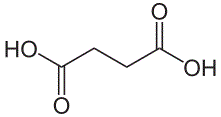
Succinic acid or butanedioic acid.

Succinic acid or butanedioic acid.

  • Pages

  • Categories

  • Enter your email address to follow this blog and receive notifications of new posts by email.

    Join 259 other subscribers
  • Follow Innovation in PU on Twitter