SHSM Polyurethanes

Title: SHAPE-MEMORY-SELF-HEALING POLYMERS (SMSHPS)

 Number/Link: WO2015119688

Applicant/Assignee: University of Florida

Publication date: 13-08-2015

Gist”: Self-healing shape memory polyurethanes made by incorporation of DA adducts in-chain

Why it is interesting: According to this invention self-healing shape memory polyurethanes can be prepared by incorporating Diels-Alder (DA) adducts into the PU network such that the DA adducts do not contribute to the crosslinking.  In this manner the material can be heated above Tg without breaking crosslinks thereby inhibiting permanent distortion of the memorised shape. The Tg is also chosen such that it is lower than the temperature at which the retro-DA reaction readily occurs. The DA adducts can be introduced using a DA adduct-containing diol as for example the adduct of a furfuryl alcohol and N-(2-hydroxyethyl)maleimide.  The SHSM polyurethanes are said to be useful for coatings and moulded materials.

Diol containing a Diels-Alder adduct
Diol containing a Diels-Alder adduct

Triptycene Chain Extenders

Title: TRIPTYCENE MONOMER AND TRIPTYCENE CONTAINING POLYESTERS AND POLYURETHANES

 Number/Link: US20150191408

Applicant/Assignee: not yet recorded. Research supported by US Army

Publication date: 9-07-2015

Gist”: A novel primary diol derived from triptycene is useful as chain extender for polyurethanes and polyesters.

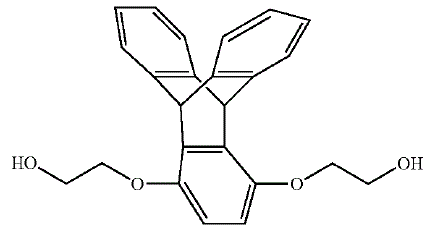
Why it is interesting: Polymers with increased mechanical properties and stiffness can be obtained by incorporating rigid structures in the polymer chain.  This however also results in increased glass transition temperature and reduced ductility because of reduced chain flexiblity and entanglements.  According to this invention polyurethanes (and copolyesters) with high modulus and good ductility at low temperatures can obtained by using triptycene-1,4-hydroquinone-bis(2-hydroxyethyl ether) or TD. In and example TD capped with PEG400 is reacted with a 4,4’MDI- PTMEG1000 prepolymer.  The resulting material indeed has a very low softblock Tg of  -65ºC and a much higher Y modulus compared to a PU made with HQEE as chain extender. According to the inventors the PU is highly suitable as a matrix material in KEVLAR or UHMWPE fiber composites.
In my opinion this is a very interesting chain extender as it appears to prevent H-bond formation and increase molar volume thereby substantially decreasing Tg. However lack of availability, and (most probably) price, will prevent this from becoming mainstream anytime soon.

Tryptycene-1,4-hydroquinone-bis(2-hydroxyethyl ether)

Triptycene-1,4-hydroquinone-bis(2-hydroxyethyl ether)


TPU from Three Types of Polyol and TODI

Title: THERMOPLASTIC POLYURETHANE FOR SEAL APPLICATIONS

 Number/Link:WO2015/090916 (German)

Applicant/Assignee: Carl Freudenberg

Publication date: 25-06-2015

Gist”: TPU based on blend of a polyester- polyether- and polycarbonate diols has exceptional properties

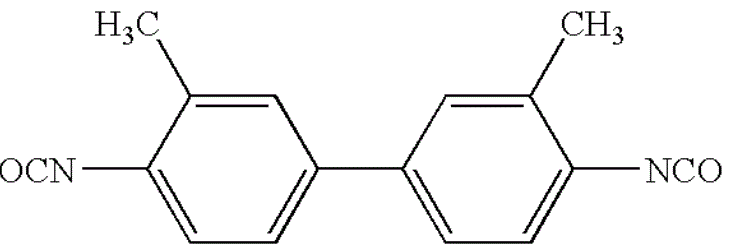
Why it is interesting: According to this application, TPUs prepared from blends of polyether, polyester and polycarbonate diols, result in materials with very high hydrolysis resistance, mechanical properties, high- ánd low temperature resistance and with excellent processing properties. In the examples 2000 MW polyether-, polycarbonate- and polycaprolactone diols are blended, reacted with toluidinediisocyanate (TODI) and subsequently extended with butanediol.  Surprisingly there appears to act some kind of synergy resulting in properties higher than would be expected from the individual polyol components.

3,3'-Dimethyl-4,4'-Biphenyldiisocyanate (TODI)

3,3′-Dimethyl-4,4′-Biphenyldiisocyanate (TODI)

  • Pages

  • Categories

  • Enter your email address to follow this blog and receive notifications of new posts by email.

    Join 259 other subscribers
  • Follow Innovation in PU on Twitter