TPU with Anti-Biofouling Surface

Patent Title: ANTIFOULING COMPOSITION

 Number/Link: WO2017/007899

Applicant/Assignee: BASF

Publication date: 12-jan-2017

Gist”: TPU containing silicone diol and having microstructured surface

Why it is interesting: Biofouling of surfaces e.g. in the marine environment or of medical implants is a problem.  For example the growth of barnacles on the hulls of vessels, subsea cables, pipes and energy generating structures has a significant economic impact. According to this invention, thermoplastic polyurethane articles with a surface energy of about 20 mN/m and a microstructered surface topography show an improved resistance to biofouling. The TPU is produced by incorporating 5-15% on the total composition of a PDMS diol with a OH value of 15 to 150, and by pressing onto the surface a 3D topology with ‘peaks’ and ‘valleys’ of an order of magnitude of 10μm.

Microstructured surface according to the invention

Microstructured surface according to the invention

Flexible PU Foams Containing Latent Aldehydes

Patent Title: IMPROVEMENTS RELATING TO POLYURETHANES

 Number/Link: WO2017/001543

Applicant/Assignee: Shell

Publication date: 5 january 2017

Gist”: Flex foams from polyether polyols containing latent aldehydes show improved compression set

Why it is interesting: Aldehydes are a by-product of the alkylene oxide production. These aldehydes need to be removed before the alkylene oxide can be used in the manufacture of polyether polyols because even minor amounts of these impurities are considered undesirable and detrimental for polyol and foam properties. According to this invention, omitting the extra purification step of the alkylene oxide results in polyols with a certain amount of free- and latent aldehydes.  (‘latent aldehyde’ being an aldehyde incorporated in the polyether polyol with a labile bond). After removal of the free aldehyde, the polyols with (pref) >150ppm latent aldehydes (mostly propionaldehyde and acetaldehyde) can be used in the preparation of flexible foam with improved wet and dry compression set properties. While the examples indeed show some (but not a dramatic) improvement of compression set, no mention is made of eventual release of the aldehydes in the atmosphere, which (in my opinion) is a much bigger problem than compression set.

Propionaldehyde

Propionaldehyde

Non-Isocyanate Polyurethanes from Sucrose-Fatty Acid Esters

Patent Title: BIOBASED CYCLIC CARBONATE FUNCTIONAL RESINS AND POLYURETHANE THERMOSETS THEREFROM

 Number/Link: US2016/0312060

Applicant/Assignee: NDSU

Publication date: 27-10-2016

Gist”: Epoxidized sucrose-fatty acid esters are reacted with CO2, then with polyamines

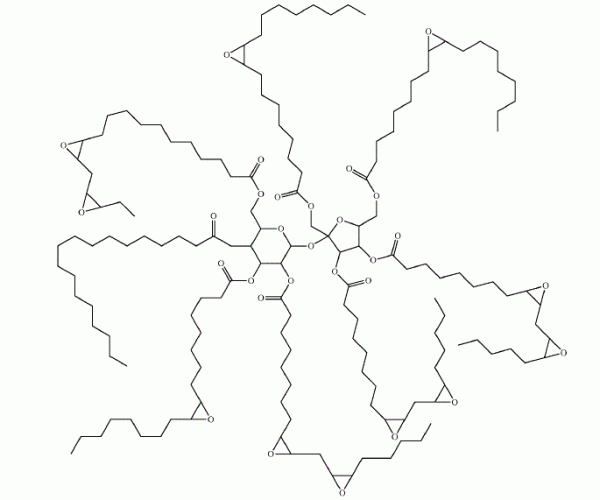
Why it is interesting:  Esters of unsaturated fatty acids and sucrose have been known since the 1960s and are useful in e.g. coatings.  Highly subsituted sucrose esters with an average of 7.7 fatty acid chains per molecule, a molecular weight of about 2400 and a relatively low viscosity of 300-400 mPa.s are commercially available. According to this invention, epoxidized sucrose-fatty acid esters can be further reacted with carbon dioxide resulting in a resin with a ‘pluraility’ of cyclocarbonate groups. Curing with polyamines results in highly crosslinked poly(hydroxyurethanes) useful for coatings, composites and adhesives.

Epoxidized sucrose-fatty acid ester

Epoxidized sucrose-fatty acid ester


  • Pages

  • Categories

  • Enter your email address to follow this blog and receive notifications of new posts by email.

    Join 259 other subscribers
  • Follow Innovation in PU on Twitter