PLA-PPG-PU Block Copolymers

Title: LACTIDE COPOLYMER, METHOD FOR PREPARING SAME, AND RESIN COMPOSITION COMPRISING SAME

 Number/Link:US2015/0284516

Applicant/Assignee: LG Chem

Publication date: 8-10-2015 (Priority PCT/KR)

Gist”: Polyether-polylactide block copolymers are prepared using ROP and then extended with isocyanates

Why it is interesting: Polylactic acid (PLA) is a well known renewable and biodegradable polymer often used in the form of films or sheets for disposable packaging. The polymer is however not very flexible and the films have poor mechanical properties. According to this invention both flexibility and mechanical properties can be greatly improved by making polyether-polylactide copolymers and then extending these using an isocyanate with a functionality of more than 2. The copolymers are made by ring-opening polymerization of lactide monomer using a polyether diol as a ‘macro’ initiator together with a specific catalyst. In the examples an excess L-lactide monomer is used which is reacted with a 4000 to 6000 mole weight polypropylene glycol, resulting in a block copolymer with a Mw of more than 100,000.  The block copolymer is then reacted with a mixture of MDI and hexamethylenediisocyanate isocyanurate, after which the residual lactide is removed.

L-Lactide

L-Lactide

SHSM Polyurethanes

Title: SHAPE-MEMORY-SELF-HEALING POLYMERS (SMSHPS)

 Number/Link: WO2015119688

Applicant/Assignee: University of Florida

Publication date: 13-08-2015

Gist”: Self-healing shape memory polyurethanes made by incorporation of DA adducts in-chain

Why it is interesting: According to this invention self-healing shape memory polyurethanes can be prepared by incorporating Diels-Alder (DA) adducts into the PU network such that the DA adducts do not contribute to the crosslinking.  In this manner the material can be heated above Tg without breaking crosslinks thereby inhibiting permanent distortion of the memorised shape. The Tg is also chosen such that it is lower than the temperature at which the retro-DA reaction readily occurs. The DA adducts can be introduced using a DA adduct-containing diol as for example the adduct of a furfuryl alcohol and N-(2-hydroxyethyl)maleimide.  The SHSM polyurethanes are said to be useful for coatings and moulded materials.

Diol containing a Diels-Alder adduct

Diol containing a Diels-Alder adduct

Classic PU patent of the Month: PORON ® Foams (1979)

Title: Polyurethane foam product and process of manufacture thereof from thermosetting frothed mixture

 Number/Link: US4216177

Applicant/Assignee: Rogers

Publication date: 5-08-1980

Gist”: Frothed flexible foam

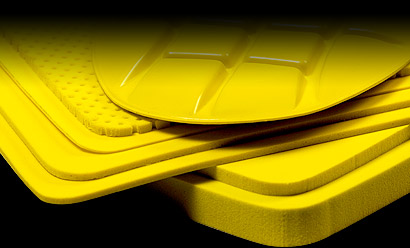
Why it is interesting: PORON is a popular brand of microcellular elastomeric/flexible polyurethane foams produced by Rogers Corporation. The original process, as documented in this patent, is quite simple:  a flexible foam formulation (in the examples) based on TDI, caprolacton diol, polymer polyol, some chain extender, amine catalyst and surfactant is frothed instead of blown with water or a physical blowing agent. The reacting froth is poured on release paper and heated to cure. Release paper can also be applied on top resulting in an integral skin on both sides of the layer. Frothing instead of blowing results in an improved compression set, different hardness-density relationship and a better control over cell structure. A unique material.

PORON foams

PORON foams

  • Pages

  • Categories

  • Enter your email address to follow this blog and receive notifications of new posts by email.

    Join 259 other subscribers
  • Follow Innovation in PU on Twitter