Self-Healing Polyurethane Elastomers

Patent Title: POLYURETHANE

 Number/Link: W02016185172

Applicant/Assignee: Croda

Publication date: 24-11-2016

Gist”: PU from polyols which contain both a fatty dimer residue and an H-bonding group, show self-healing properties

Why it is interesting: Polyurethane elastomers with ‘intrinsic’ self-healing properties (i.e. without the need for external chemicals like encapsulated monomers) can be prepared by reacting isocyanates with polyols that have at least one urethane, amide or carbonate group and at least one fatty dimer residue. It is theorized that the fatty dimer allows the soft-phase of the polymer to flow and H-bonds to form, thus restoring most of the properties after damage.  In the examples polyols with internal urethane groups were prepared by reacting C36 dimer diol with HDI, which were then reacted with MDI and BDO. Samples of the resulting elastomers were cut in half, and manually stuck together again under mild heating (60°C), thus recovering most of their tensile and elongation properties.

A dimer diol
A dimer diol

Polyurethane-Polyamides from Dimer Diacids

Title: A POLYOL BASED ON DIMER FATTY ACID RESIDUES AND THE CORRESPONDING POLYURETHANES

 Number/Link:WO2015/097433

Applicant/Assignee: Croda

Publication date: 2-07-2015

Gist”: Polyurethane/polyamide elastomers based on dimer diacids and long chain dicarboxylic acids

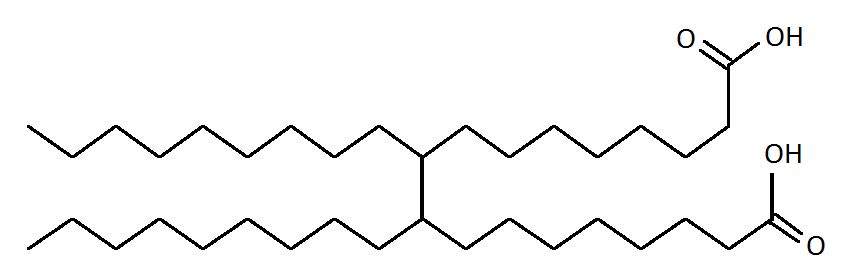
Why it is interesting: Polyurethane elastomers (and thermoplastic elastomers) based on dimer diacids or dimer diols are very hydrophobic and hydrolysis resistant but are relatively soft with lowish mechanical properties. According to this invention, using a blend of a dimer diacid (or -diol) and a (semi-) crystalline C17 to C32 dicarboxilic acid (or -diol) results in elastomers with greatly improved hardness and tensile strength while retaining flexibility and hydrolysis resistance. The C17 to C32 dicarboxylic acids can be prepared by a self-metathesis reaction of unsaturated fatty acid esters.  In the examples a C36 dimer diacid is used together with 1,18-octadodecanoic acid (prepared by metathesis from methyl oleate).  This is reacted ‘one shot’ with 4,4′ MDI and hexanediol or DEG, resulting in 85 shore A elastomers with high elongation and hydrolysis resistance.

A C36 dimer diacid

A C36 dimer diacid

  • Pages

  • Categories

  • Enter your email address to follow this blog and receive notifications of new posts by email.

    Join 259 other subscribers
  • Follow Innovation in PU on Twitter