Unique Type of Polyurethane Flexible Foam to Reduce Tyre Noise

Title: TYRE, THE INNER WALL OF WHICH HAS A LAYER OF SPECIFIC POLYURETHANE FOAM

 Number/Link: WO2013/182477 (French)

Applicant/Assignee: Michelin

Publication date: 12-12-2013

Gist”: A layer of flex foam is used to reduce cavity noise in car tyres, the foam being prepared form high EO polyol and 4,4′ MDI.

Why it is interesting: An important component of the noise produced by driving vehicules is attributed to resonances in the tyre cavities. It is know that this noise can be reduced by (partly) filling the tyre cavity with PU foam, but the foams are difficult to apply, add too much weight and do not show enough sound absorption. According to this invention these problems can be solved by adhering a layer of a specific flexible foam to the inside of the tire.  The foam has a low density (30 to 60 kg/m³), and absorbs sound at the correct frequency for cavity resonances (190-230Hz).  It is prepared from a prepolymer based on a  70-90% EO polyol and 4.4′ MDI, which is mixed with water and catalyst.  The reacting mixture is poured into a spinning tyre where it cures and adheres to the inside of the cavity.
This foam -inlcuding the prepolymer- was actually invented by myself in 1991: EP547765
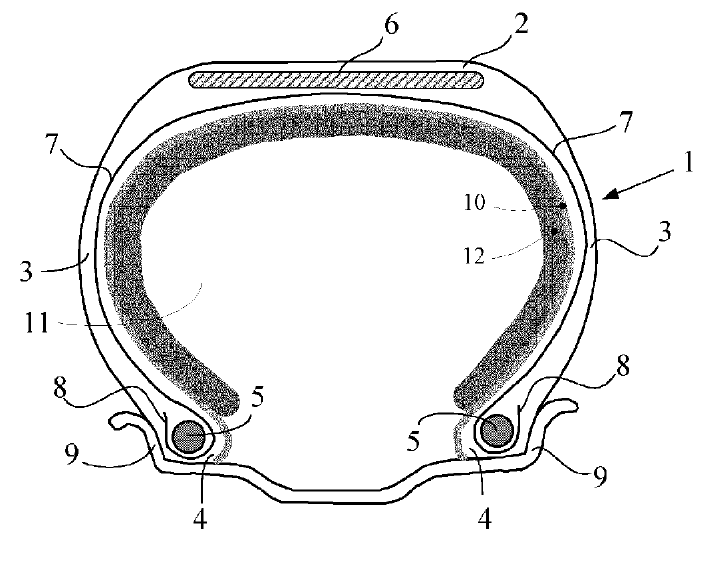
Cross-section of foam-lined tire according to the invention.

Cross-section of foam-lined tire according to the invention.

Flexible Foams containing Polyurethane Phase Change Gels

Title: Polyurethane Gel-Like Polymers, Methods and Use in Flexible Foams  

 Number/Link: US2013/0296449

Applicant/Assignee: PETERSON CHEMICAL TECHNOLOGY

Publication date: 07-11-2013

Gist”:   “Polyurethane phase change gels” prepared from polyurethane gels and conventional PCMs are incorporated into polyurethane or latex flexible foams to improve thermal comfort.

Why it is interesting: This application is closely related to the application discussed in the previous post but instead of a plasticized styrenic triblock copolymer, now a polyurethane gel is used. The PU gel is produced from conventional raw materials at low NCO-index (about 60%) together with plasticizers.

A Polyurethane Gel

A Polyurethane Gel

Incorporating “Phase Change Gels” into Flexible Foams for Improved Thermal Comfort

Title: Thermal Storage Gelatinous Triblock Copolymer Elastomer Particles in Polyurethane Flexible Foams

 Number/Link: US2013/295371

Applicant/Assignee: PETERSON CHEMICAL TECHNOLOGY

Publication date: 07-11-2013

Gist”:  Particles of  “phase change gels” prepared from plasticized styrenic TPEs and conventional PCMs are incorporated into polyurethane or latex flexible foams

Why it is interesting: A conventional phase change material (PCM) selected from alkanes, PEGs, hydrated salts ect. with a transition temperature between 20 and 35°C is melt-blended with a plasticized styrenic triblock copolymer like SBS, SIS, SEBS etc. to form a “phase change gel”. The gel is then comminuted and added to a flexible foam forming composition in an amount of about 30 pphp. The resulting foams have an increased thermal conductivity which together with the temperature buffering properties of the PCM improves thermal comfort. The flexible foams are useful in application such as matresses, pillows, automotive cushioning, shoe inserts, medical foams and the like. In my opinion especially useful for viscoleastic (“memory”) foams which are known to suffer from thermal discomfort problems.

Effect of "gel PCM" on heating rate of flexible foam according to the invention.

Effect of “gel PCM” on heating rate of flexible foam according to the invention.

  • Pages

  • Categories

  • Enter your email address to follow this blog and receive notifications of new posts by email.

    Join 259 other subscribers
  • Follow Innovation in PU on Twitter