Polyols from Urethane Alcohols

Title: USE OF URETHANE ALCOHOLS FOR PREPARATION OF POLYETHER POLYOLS

 Number/Link: WO2015075057

Applicant/Assignee: Bayer

Publication date: 28-05-2015

Gist”: Urethane alcohols prepared from cyclocarbonates are used as starters for polyether polyols

Why it is interesting: Urethane diols are prepared by reacting cyclic carbonates like ethylene- or propylene carbonate with an alkanolamine like e.g. ethanolamine. The alcohols are then further reacted with propylene oxide and/or ethylene oxide to make polyether polyols, useful for the production of flexible foams a.o.  No comparison of the properties of these polyols (or of the resulting foams), with ‘conventional’ polyether polyols, is given. The only advantage (at least for Bayer) being that the polyols are partly based on cyclocarbonates which are by-products of the polycarbonate polyol production.
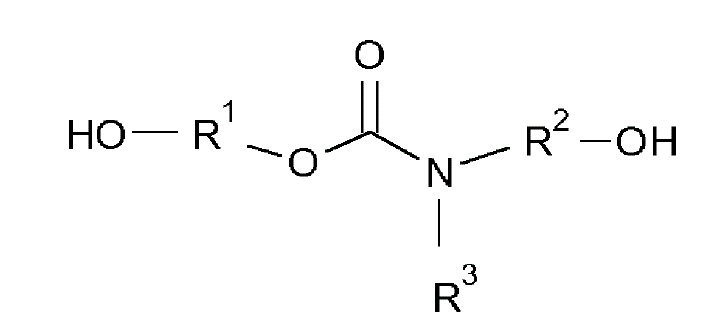
A Urethane Alcohol
A Urethane Alcohol

Self-Healing Polyurethanes

Title: SELF-HEALING POLYURETHANES

 Number/Link: WO2015/067833 (Spanish)

Applicant/Assignee: Fundacion Gaiker

Publication date: 14-05-2015

Gist”: Self-healing polyurethanes coatings can be prepared using dihydroxy coumarin derivatives

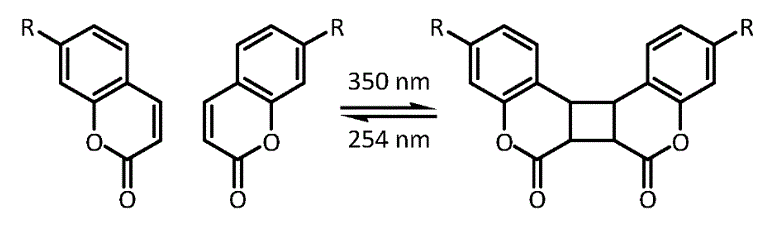
Why it is interesting: Self-healing polymers have been made before using e.g. microencapsulated ‘healing agents’ or supramolecular chemistry such as hydrogen-bond formation.  This patent application relates to polyurethanes having photochemical self-healing properties, which, in contrast to previous systems, have the advantage of allowing for multiple recoveries and for (potentially) being transparent. The self-repairing PU systems are based on the photodimerization and photocleavage reactions of coumarine-derivatives as shown in the scheme below.  Dihydroxy derivatives of coumarine can be built into PU coatings sytems. Damaged coatings can then be radiated with light of a wavelength of (pref.) 254nm to cleave coumarin dimers present, followed by radiation of about 340nm to (re-)form the dimers and repair the coating.

Photodimerization and -cleavage of coumarine derivatives

Photodimerization and -cleavage of coumarine derivatives

Hydrophobic Thermoplastic Polyurethanes

Title: POLYURETHANE

 Number/Link: US2015/0119535

Applicant/Assignee: Nippon Soda

Publication date: 30-04-2015 (priority PCT/JP)

Gist”: TPU based on a ‘hybrid’ polybutadiene-polyester polyol and an asymmetric isocyanate

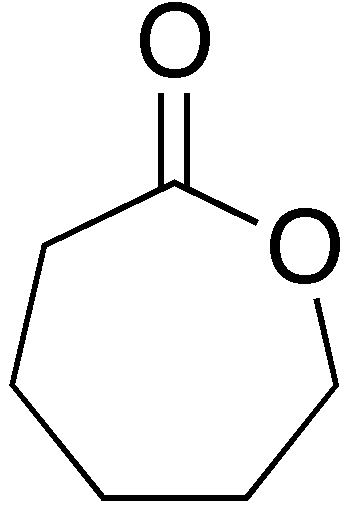
Why it is interesting: According to this invention, TPUs with excellent water-resistance can be prepared from a polyol which is made by reacting a polybutadiene diol with a mole weight of a few 1000 with a cyclic ester monomer, up to a mole weight of about 5000 to 15000 (preferred).  The resulting ‘hybdrid’  (polyester-polybutadiene-polyester) polyol is then prepolymerized with a surplus of an assymetric di-isocyanate. Finally the prepolymer is reacted with a chain extender to make the TPU. In the examples polybutadiene diols are reacted with ε-caprolactone and then with IPDI or 2,4-TDI.  The chain extender used is 1,4-butanediol. Interesting materials and (but) relatively soft as would be expected.

Caprolactone

Caprolactone

  • Pages

  • Categories

  • Enter your email address to follow this blog and receive notifications of new posts by email.

    Join 259 other subscribers
  • Follow Innovation in PU on Twitter