TPU from Biorenewable Isocyanate

Patent Title: BIO-BASED DIISOCYANATE AND CHAIN EXTENDERS IN CRYSTALLINE SEGMENTED THERMOPLASTIC POLYESTER URETHANES

 Number/Link: WO2016041076

Applicant/Assignee: Trent University

Publication date: 24-03-2016

Gist”:  TPU with highly crystalline hard segment is based on 1,7 heptamethylenediisocyanate

Why it is interesting: According to this application, polyester TPUs with crystalline hard segments can be produced using 1,7-heptamethylenediisocyanate. The HPMDI is reacted with a 2000MW poly(ethyleneadipate) diol and a short chain diol as chain extender. The  TPUs show a high hard-segment crystallinity, resulting in improved phase separation and in a (semi-)crystalline softphase which has a significant reinforcement effect. The TPUs are thermally stable up to 250°C and show a toughness and strength comparable to conventional TPUs. HPMDI can reportedly be made from natural oils using the Curtius rearrangement – but no reference is given.
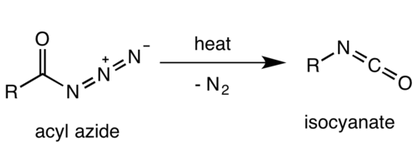
Curtius Rearrangment


Curtius Rearrangment

Vinyl-Functional UV-Curable Polyurethanes

Patent Title: ALKENYL ETHER POLYOLS

 Number/Link: WO2016038112 (German)

Applicant/Assignee: Henkel

Publication date: 17-03-2016

Gist”: Alkenylether-functional polyols are used in oligomeric PU adhesives.

Why it is interesting: Alkenylether-functional groups are highly reactive and can be cured by UV-initiated cationic polymerization. This has the advantage of being unsensitive to oxigen which allows for so-called “dark cure”, i.e. the continuing polymerization after a first pulse of UV light. According to this invention, vinyl functional polyols are prepared by polymerizing a hydroxyl- or amine functional vinyl ether, e.g. 4-hydroxybutylvinylether (HBVE) or 3-aminopropylvinylether with epoxides or cyclocarbonates. The polyols can then be reacted with isocyanates resulting in UV curable polyurethanes.  In an example HBVE is reacted with 1,4-butanedioldiglycidylether to make the vinyl-functional polyol which is then further reacted with isophorondiisocyanate to make the PU adhesive.

1,4-butandioldiglycidylether

1,4-butandioldiglycidylether

Classic PU Patent of the Month: ICI on Non-Isocyanate Polyurethanes (1961)

Title: Polyurethanes

 Number/Link: GB944310

Applicant/Assignee: Imperial Chemical Industries

Publication date: 11-12-1963

Gist”: Non-isocyanate polyurethanes by transurethanization of bis-carbamates and polyols.

Why it is interesting: Because of the growing concern over isocyanate toxicity and related changes in legislation, research and development of non-isocyanate polyurethane (NIPU) systems has increased sharply over the last few years. The idea, and most of the chemistry of NIPU is by no means new. In this patent, filed by ICI in 1961, NIPU is prepared by transesterification of bis-carbamates and polyols with a functionality of 2 or more. The materials are said to be especially useful for coatings and as TPU for fiber production. According to the patent, the advantages of this reaction system over the use of isocyanates are the reduction of the toxicity hazard, less moisture sensitivity and no need to carefully control reaction conditions and reactant proportions.  In an example N,N’-methylene-bis-urethane was reacted with 1,4-butanediol catalyzed by DBTDL resulting in a TPU which could be melt-drawn into fibers.  (Note that, in this case, ‘urethane’ is the common name for ethylcarbamate).

ICI logo anno 1961.

ICI logo anno 1961

  • Pages

  • Categories

  • Enter your email address to follow this blog and receive notifications of new posts by email.

    Join 259 other subscribers
  • Follow Innovation in PU on Twitter