Polyurethane Foams from Sugar

Title: Sugar-Based Polyurethanes, Methods for Their Preparation, and Methods of Use Thereof

 Number/Link: US2013030067

Applicant/Assignee: Imperial Sugar Co.

Publication date: 31-01-2013

Gist”: Very low density semi-rigid foams are produced from sucrose syrup and MDI.

Why it is interesting: Open celled foams are prepared from sucrose, water, MDI and preferably a  flame retardant at an NCO index from 20-60 (preferred). A number of examples is given of foams with densities 0f 8 kg/m3 (0.5 pcf) which is quite low.  Mechanical an heat insulation properties are probably not very good but the foams are very ‘green’ and cheap. Useful as sprayable acoustic foams?

Sucrose

Sucrose

Insulating Elastomer-Aerogel Composites

Title: INSULATING MATERIAL COMPRISING AN ELASTOMER IMPREGNATED WITH AEROGEL-BASE

 Number/Link:  US2013022769

Applicant/Assignee: UNIV MEMPHIS

Publication date: 24-01-2013

Gist”: Elastomeric material containing aerogel ‘bodies’, useful for heat insulation.

Why it is interesting:  The elastomeric matrix material can be any kind of thermoset or thermoplastic rubber, including polyurethanes but RTV silicones are preferred. The aerogels can be organic, inorganic or hybrid, but are preferably polyurea-crosslinked silicas of any geometrical shape,  preferably 1-5mm in size with an aerogel:polymer ratio of 15:100 to 200:100 (w/w). Both insulation and mechanical properties compare favourably to ASPEN aerogel blankets. Useful for insulation of cryogenic fuel tanks a.o.

Space shuttle with PU insulated cryogenic fuel tank.

Space shuttle with PU insulated cryogenic fuel tank. (Wikimedia)

Reticulated Foam-Fiber Composites

Title: A RETICULATED OPEN-CELL FOAM MODIFIED BY FIBERS EXTENDING ACROSS AND BETWEEN THE CELLS OF SAID FOAM AND PREPARATION METHODS THEREOF

 Number/Link: WO2013010245

Applicant/Assignee: EPIC VENTURES INC

Publication date: 24-01-2013

Gist”: Reticulated polyurethane foams containing fibers extending across and between cells. The foams can then be impregnated with metals (Nickel) and the polymer pyrolized resulting in porous metal structures useful in batteries.

Why it is interesting:  Reticulated foams (i.e. foams consisting only of a ‘strut skeleton’ and having no cell membranes) are well known, but the application is not clear about which process is to be used in this case, neither does it provide an example of a formulation. Chopped metal, glass or carbon  fibers are added to the foam-forming composition supposedly ‘resulting’ in a reticulated foam/fibre composite.  The fibers extend over about 5 cell diameters (e.g. 1-1.5 mm ) and are used in 10-30% v/v. Foams like this could be interesting for filtration, heat exchange and especially sound absorption -with  the fibers adding extra “tortuosity”. The patent is mainly concerned with the subsequent production of metal foams for use in batteries e.g.
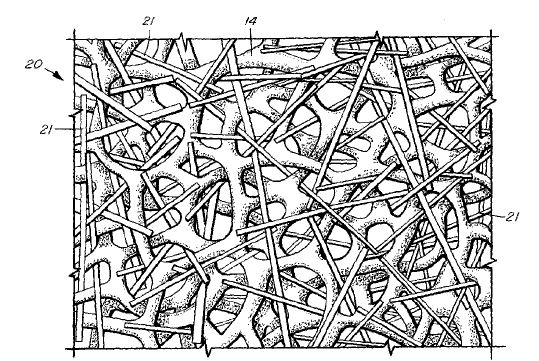
Reticulated Foams with Fibers

Reticulated Foam with Fibers

  • Pages

  • Categories

  • Enter your email address to follow this blog and receive notifications of new posts by email.

    Join 259 other subscribers
  • Follow Innovation in PU on Twitter