Rigid Polyurethane Foam from Modified Polymer Polyols

Title: METHOD FOR PRODUCING RIGID POLYURETHANE FOAMS

 Number/Link: WO2013/024101  (German)

Applicant/Assignee: BASF

Publication date: 21-02-2013

Gist”: Polymer polyols comprising surface-active and reactive SAN particles for improved rigid foams.

Why it is interesting: In this invention polymer polyols are prepared by in-situ co-polymerisation of styrene, acrylonitrile (preferred) and a polyether siloxane surfactant comprising at least one  unsaturated group and at least one hydroxyl group. This will result in a polymer polyol (or “graft polyol”) comprising surface-modified particles, which, when used to prepare rigid foams, will end up predominantly (>50%) in the cell walls rather than in the cell struts. This is new and surprising. The rigid foams should show improved insulation properties and compressive strength.

surface active monomer used in the invention

surface active monomer used in the invention

Composite Polyurethane-Polystyrene Thermal Insulation Foams

Title:  METHOD FOR PRODUCTION OF HEAT INSULATING COMPOSITE MATERIALS AND HEAT INSULATING COMPOSITEMATERIAL PRODUCED THEREBY

 Number/Link: WO2013/021324

Applicant/Assignee: HIT KONSULTING

Publication date: 14-02-2013

Gist”: Expandable polystyrene beads are added to rigid PUR or PIR foam system.

Why it is interesting: EPS beads with a softening temperature of 80-90°C are added to the isocyanate stream in an amount of 15-60% w/w to the total system. The exotherm has to be exactly right to fully expand and not degrade the EPS, and is controlled by the ratio PU/EPS.  This idea is not new, but it remains an interesting route to cheap insulation. The claim is relatively narrow so could get granted imo.

Expandable Polystyrene (Wikimedia)

Expandable Polystyrene (Wikimedia)

Viscoelastic Polyurethane Foam with Porous Struts

Title: CELLULAR STRUCTURES AND VISCOELASTIC POLYURETHANE FOAMS

 Number/Link: US2013035413

Applicant/Assignee: DOW GLOBAL TECHNOLOGIES

Publication date: 7-02-2013

Gist”: The use of high equivalent weight polybutylenoxide monol together with a polyol mixture and TDI to produce a viscoelastic  foam with greatly improved airflow.

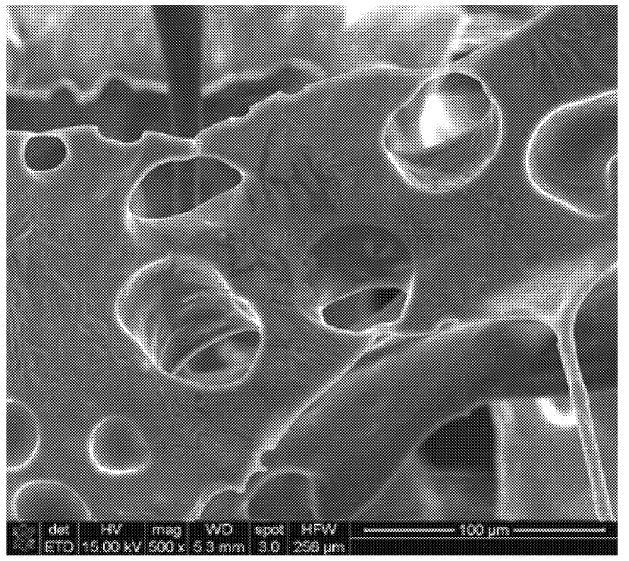
Why it is interesting: Most viscoelastic (or “memory”) foams are used in bedding and often have the disadvantage of building up heat and moisture during use, resulting in the loss of viscoelastic properties and deterioration in comfort. Improving the airflow through the foam should reduce this effect. Dow now appears to have cracked the airflow problem by using  a polybutylene oxide monol (preferred) with and eq.wt. of about 4000, together with a conventional blend of high EO and high PO polyols and TDI80 (in the examples).  Air flow indeed seems to be greatly improved and even the cell struts appear to be perforated!  Great stuff.

Foams cells showing porous struts

Foams cells showing porous struts

  • Pages

  • Categories

  • Enter your email address to follow this blog and receive notifications of new posts by email.

    Join 259 other subscribers
  • Follow Innovation in PU on Twitter