Polyurethane Foams with Reduced Acetaldehyde Emissions

Patent Title: POLYURETHANES WITH REDUCED ALDEHYDE EMISSION

 Number/Link: WO2015/189095

Applicant/Assignee: BASF

Publication date: 17-12-2015

Gist”: A polymer with pending -O-NH2 groups is used as additive

Why it is interesting: The reduction of VOC emissions, especially emissions of aldehydes from PU foams, remains an important topic of research. A number of solutions have been proposed, for example the use of polyamines as scavengers as discussed before. There still appears to be a need for improvement however, especially for the reduction of acetaldehyde emissions. According to this invention acetaldehyde emissions can be reduced by using a relatively high mole-weight polymer with pending aminooxy groups as an additive during foaming. In an example a copolymer of 4-aminooxymethylstyrene and methacrylic acid with a Mn of about 15,000 is used as an additive.

Aminooxymethylstyrene

4-aminooxymethylstyrene

Aerogels from Urethane-Acrylate Star Monomers

Title: FLEXIBLE TO RIGID NANOPOROUS POLYURETHANE-ACRYLATE (PUAC) TYPE MATERIALS FOR STRUCTURAL AND THERMAL INSULATION APPLICATIONS

 Number/Link:US2015/0266983

Applicant/Assignee: University of Missouri

Publication date: 24-09-2015

Gist”: A trifunctional acrylate-ended urethane monomer is polymerized in solvent and supercritically dried

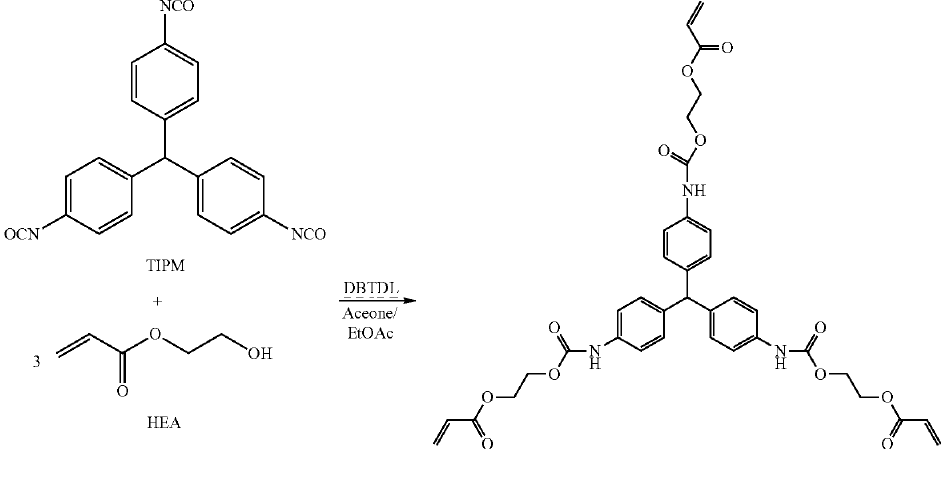
Why it is interesting: Research related to nanoporous materials has been gaining significant momentum in recent years and both inorganic (usually silica-based) and organic (e.g resorcinol-formaldehyde or polyurethane -based) aerogels are increasingly being used especially for thermal insulation applications. The current invention relates to hybrid PU-AC aerogels prepared from acrylate functional “star” monomers. The monomers are made by reacting a tris(isocyanatoaryl)methane with one or more hydroxyacrylates in a suitable solvent.  The monomer is then radically polymerized and the resulting ‘wet’ gel is supercritically dried into an aerogel. In the examples tris(4-isocyanatophenyl)methane is reacted with 2-hydroxyethylacrylate in ethyl acetate. The monomer solution is polymerized by heating with a radical initiator and the resulting gel is then dried using acetone and supercritical CO2.  The resulting aerogels have a density ranging from about 135 to 650 kg/m³ with a porosity bewteen 90 and 50% (v/v).  The lower density aerogels are flexible and have a thermal conductivity of about 40 mW/m.K.

Star monomer according to the invention

Star monomer according to the invention

PU Rigid Foams with very Small Cell Size

Title: RIGID POLYURETHANE FOAM HAVING A SMALL CELL SIZE

 Number/Link: WO2015/109488

Applicant/Assignee: Dow

Publication date: 30-07-2015

Gist”: Rigid foams are blown with CO2 under pressure

Why it is interesting: It is known that the thermal conductivity of conventional rigid polyurethane foams can be most efficiently improved by reducing the conductivity contribution of the gas present in the foam cells. This, in turn, can be achieved by reducing the gas pressure, by using ‘heavy’ blowing agents or by reducing the average cell size.  The current application discloses rigid PU foams having cell sizes small enough to achieve a thermal conductivity of less than 16 mW/m.K without the need for a strong vacuum or special blowing agents. This is achieved by first saturating the polyol formulation with CO2 under pressure, then adding the isocyanate and increasing the pressure for a set amount of time and finally releasing the pressure to allow the material to expand. Examples are given using a pressure of 7 MPa at 40°C for 30 minutes to saturate the polyol, and a pressure of 10 MPa for up to about 10 minutes after addition of the isocyanate.  Foams with average cell sizes of 8 to 70 μm and porosities of up to 90% are obtained at densities of about 250 to about 300 kg/m³.  Oddly enough no thermal conductivity (λ) values are given.

Rigid polyurethane insulation foams (Wikimedia)

Rigid polyurethane insulation foams (Wikimedia)


  • Pages

  • Categories

  • Enter your email address to follow this blog and receive notifications of new posts by email.

    Join 259 other subscribers
  • Follow Innovation in PU on Twitter