Fuel Resistant Polyurea

Title: POLYUREA COMPOSITIONS AND METHODS OF USE

 Number/Link: US20140171587

Applicant/Assignee: PRC DESOTO

Publication date: 19-06-2014 (priority PCT)

Gist”: Sulfur-containing polyformal polyols are prepolymerized with aliphatic diisocyanates and then cured with aromatic amines.

Why it is interesting: Sulfur-containing polyformal polyols are prepared from thiodiglycol and paraformaldehyde using acidic catalysis.  The polyols are then reacted with 4,4′-dicylcohexyl diisocyanate (H12MDI) to form a prepolymer which is subsequently cured with an aromatic amine like dimethylthiotoluenediamine. The resulting material is water and fuel resistant and can be used as a sealant in the aerospace industry.

H12MDI-thiodiglycol-polyformal adduct

H12MDI-thiodiglycol-polyformal adduct

“Green” Isocyanate: Renewable and Phosgene-Free

Title: POLYISOCYANATES FROM FUSED BICYCLIC POLYOLS AND POLYURETHANES THEREFROM

 Number/Link: WO2014/062631

Applicant/Assignee: IOWA STATE UNIVERSITY

Publication date: 24-04-2014

Gist”: Isocyanates from acyl azides derived from isosorbide

Why it is interesting:  Fused bicyclic polyols are reacted with anhydrides to form polyacids which are converted to acyl halides which in turn are converted to acyl azides.  The acyl azides rearrange to isocyanates (Curtius Rearragment).  For example isosorbide is reacted with succinic anhydride, then with thionylchloride (SOCl2) to form the di-acylchloride and then with sodium azide (NaN3) to form the di-acylazide which rearranges into the di-isocyanate under liberation of nitrogen. The isocyanate can be reacted with more isosorbide to form a polyurethane. Clever chemistry but hard to judge if it is industrially viable.

Completely renewable polyurethane according to the invention . Click to enlarge.


Highly Stable Isocyanate Dispersions

Title: STORAGE-STABLE HYDROPHILIC POLYISOCYANATES

 Number/Link: WO2014/053269   (German)

Applicant/Assignee: Evonik

Publication date: 10-04-2014

Gist”: A uretdion-containing isocyanate prepolymer is reacted with a neutralized aminealkylsulfonic acid to produce a novel hydrophilic (latent) isocyanate which can be used in stable aqueous dispersions.

Why it is interesting: Aqueous dispersions of isocyanates are useful in many applications as adhesives, binders, crosslinkers etc, but usually suffer from a relatively short shelf life.  Dispersions prepared according to the current invention supposedly lose less than 30% of their initial NCO value after 12 weeks storage at 50°C. In an example an aceton-solution of  an IPDI-uretdion prepolymer with an isocyanate content of 1.5% is reacted with the sodium salt of an aminealkylsulfonate in water to an NCO value of 0.1%. After removal of the aceton the resulting dispersion had a latent isocyanate content of 4.5%

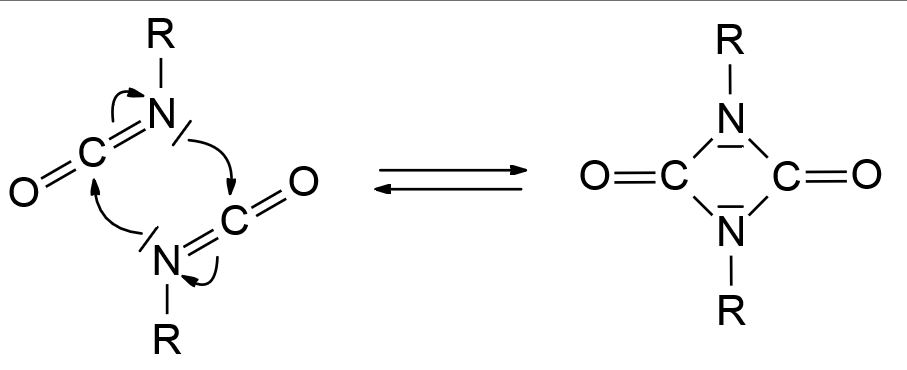
Dimerization of isocyanate to uretdion.

Reversible dimerization of isocyanate to uretdion.

  • Pages

  • Categories

  • Enter your email address to follow this blog and receive notifications of new posts by email.

    Join 259 other subscribers
  • Follow Innovation in PU on Twitter