Cross-Linked Melt-Spun Polyurethane Fibers

Title: ISOCYANATE PREPOLYMER COMPOSITION AND CROSSLINKED POLYURETHANE PREPARED THEREFROM

 Number/Link: WO2015/007731

Applicant/Assignee: BASF

Publication date: 22-01-2015

Gist”: Melt spinning a TPU – prepolymer blend.

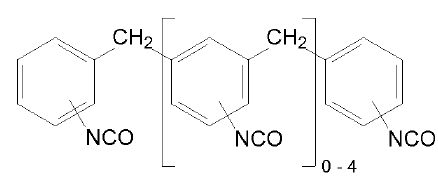
Why it is interesting: Crosslinked polyurethane fibers are produced by melt-spinning a thermoplastic polyurethane which is melt-blended with a specific isocyanate prepolymer composition.  The prepolymer composition is a mixture of a polymeric MDI and the reaction product of a polyester polyol and an excess of 4.4′-MDI. The polyester polyol is prepared from adipic acid together with 2-methyl-1,3-propanediol (MPdiol) and/or trimethylolpropane. The prepolymer composition is characterized by its low viscosity (probably due to the use of the branched polyester).  The crosslinked fibers show an improved tensile set and temperature resistance.
Polymeric MDI
Polymeric MDI

TPU from Low Free Monomeric Isocyanate Prepolymers

Title: THERMOPLASTIC POLYURETHANE FROM LOW FREE MONOMER PREPOLYMER

 Number/Link: WO2014/186111

Applicant/Assignee: Chemtura

Publication date: 20-11-2014

Gist”: TPUs with exceptional properties are produced from “full” prepolymers with a very low free monomeric isocyanate content.

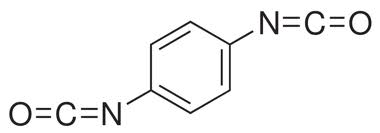
Why it is interesting: According to this invention thermoplastic polyurethanes with improved processing characteristics and with exceptional mechanical-, fatigue- and ageing properties can be produced by reacting a ‘full’ prepolymer having a low ( less than 0.5% ) free monomeric isocyanate content with a low molecular weight chain extender. PPDI and MDI prepolymers with low free monomeric isocyanate can be prepared e.g. by distillation of the prepolymer in the presence of a inert solvent with a boiling point slightly lower than the monomeric diisocyanate present (see e.g. US2009/0076239). Products like this are commerically available. The reason for the exceptional properties is undoubtedly the result of a very regular microphase structure of these TPUs.

para-phenylenediisocyanate (PPDI)

para-phenylenediisocyanate (PPDI)

Classic PU Patent of the Month: ICI on MDI Prepolymers and “Cold Cure” Flexible Foams (1978)

Title: Liquid polyisocyanate compositions

 Number/Link:  EP10850

Applicant/Assignee: Imperial Chemical Industries

Publication date: 14-05-1980

Gist”: Liquid compositions from 2,4’/4,4′-MDI  prepolymers and polymeric MDI.

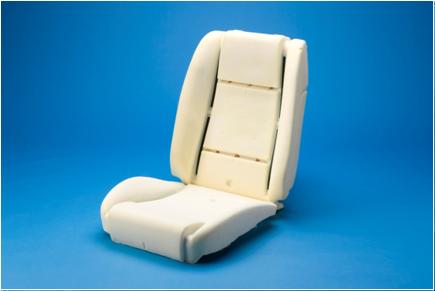
Why it is interesting: The first polyurethane flexible foams were all based on toluene diisocyanate (TDI).  Other commericially available isocyanates like “pure MDI”  (4,4’/ 2,4′- diphenylmethane diisocyanates mixtures) and “crude MDI” (mixtures of MDI and its higher homologues) were not suited for flexible foam production: the former because of it’s high crystallinity and therefore too high melting point and the latter because of its too high functionality.  This classic invention solved the problem by prepolymerizing  a 2,4’/4,4′-MDI mixture with a “flexible” polyol to an NCO content of 8 to 26% and then adding 10-50% of crude MDI to obtain a liquid composition. These liquid MDI compositions allowed the production of cold cure moulded flexible foams and the first MDI-based car seat cushions.

Cold cure moulded car seat cushions

Cold cure moulded car seat cushions

  • Pages

  • Categories

  • Enter your email address to follow this blog and receive notifications of new posts by email.

    Join 259 other subscribers
  • Follow Innovation in PU on Twitter