Non-Isocyanate Polyurethane Flexible Foams

Title: NON ISOCYANATE POLYURETHANE FOAMS

Number/LinkUS2017/0218124

Applicant/Assignee: Faurecia

Publication Date: 3 august 2017

“Gist”: Flex foams from a blend of two polyfunctional cyclocarbonates, a polyamine and HFC blowing agent.

Why it is interesting: While non-isocyanate polyurethanes are well known by now, examples of NIPU foams, especially flexible foams are rare. According to this case NIPU foams ‘having good resilience and low density’ can be prepared by reacting two polyfunctional carbonates A and B with a polyamine in the presence of a blowing agent and a catalyst. Cyclocarbonate A is (pref) trimethylolpropaneglycidylether carbonate and B is a polyetherpolyol with the OH groups replaced by glycidylcarbonate groups, for example an alkoxyalated trimethylolpropaneglycidylether carbonate. The polyamine is e.g. 1,6 diaminohexane.  The ratio A:B is preferably about 60:40.  In the examples no value for the resilience is given (but my guess based on the Tg is that it is probably not very high) and the lowest moulded density achieved is 140 kg/m³. So still a long way to go..
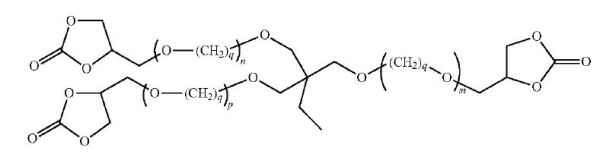
Glycidylether carbonate of alkoxylkated trimethylolpropane
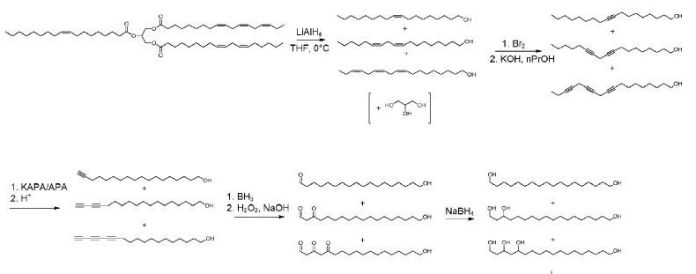
Polyols from Natural Oils using the Alkyne Zipper Reaction

Title: POLYURETHANE MATERIALS FORMED FROM UNSATURATED PLANT OILS VIA AN ALKYNE ZIPPER REACTION

Number/Link: US2017/0166679 US2017/0166680

Applicant/Assignee: IBM

Publication Date: 15-june-2017

“Gist”: Oils are turned into alkyne alcohols, ‘zippered’ and oxidized to polyols

Why it is interesting: This is yet  another IBM patent application about interesting, albeit somewhat exotic, chemistry and featuring only “prophetic” examples. In this case unsaturated natural oils are first converted into unsaturated alcohols and then into alkynes by bromination and elimination.  The internal alkynes are then converted to terminal alkynes by an “alkyne zipper reaction” and then into hydroxyl groups by hydroboration and epoxidation/ring-opening. This series of reactions should result in polyols having two primary- and one or more secondary OH groups, useful, for example, for the preparation of sound absorbing foams.

Reaction sequence according to the invention

Polycarbonate PU Foams with Reduced VOC Emissions

Title: POLYURETHANE FOAMS BASED ON POLYETHER CARBONATE POLYOLS

Number/Link: WO2017/085201 (German)

Applicant/Assignee: Covestro

Publication Date: 26-may-2017

“Gist”: Use of urea reduces the formation of propylenecarbonate from polycarbonate polyols

Why it is interesting: Covestry is betting heavily on polyethercarbonate polyols for use in polyurethane foams, using the carbon-negative footprint as a selling point. The use of polyethercarbonate polyols in PU foams can, however, result in the formation of propylenecarbonate resulting from a retro reaction promoted by conventional amine catalysts. Propylenecarbonate will contribute to the total VOC emissions of foams and other materials. According to this invention, the retro reaction can -surprisingly- be prevented or reduced by using urea or urea-derivatives in the foam formulation. In the examples urea and dimethylaminopropylurea are used together with a tin catalyst,  polyethercarbonate polyols and TDI to produce flexible foams with reduced propylenecarbonate content.

Propylenecarbonate


  • Pages

  • Categories

  • Enter your email address to follow this blog and receive notifications of new posts by email.

    Join 259 other subscribers
  • Follow Innovation in PU on Twitter