Thermoplastic PU-PS Graft Copolymers

Title: POLYURETHANE-BASED POLYMER COMPOSITION

 Number/Link: WO2014/147194

Applicant/Assignee: BASF

Publication date: 25-09-2014

Gist”: TPU microparticles react with styrene monomer resulting in a TPU-PS copolymer.

Why it is interesting: Blends of TPU with polystyrene are known, but compatibility is low and PS to TPU ratio therefore needs to be low as well  to prevent ‘delamination’ of injection moulded parts.  According to this patent application it is however possible to graft the PS onto TPU such that much higher PS/TPU ratio’s can be obtained. The TPU needs to be MDI-based and have a relatively low hardblock content and softening temperature. Apparently the PS grafts onto the MDI methylene groups which form radicals easily. In an example TPU micropellets are swollen in styrene monomer at low temperature together with dicumulperoxide as a radical initiator. The swollen particles are then dispersed in water together with an emulsifier and heated under pressure to form a 60-40 TPU-PS copolymer. A solvent-based process is also exemplified.  The resulting polymers are especially useful for injection moulded parts such as spring-aids.

MDI radical
MDI radical

Reactive Cellopener for Polyurethane Rigid Foams

Title: REACTIVE CELL OPENER COMPOSITION, POLYOL COMPOSITION, AND OPEN-CELLED POLYURETHANE FOAM

 Number/Link: US2014/0231708

Applicant/Assignee: LG Electronics

Publication date: 21-08-2014

Gist”:  A silicon oil together with the lithium-salt of 12-hydroxystearic acid is used as cellopener for rigid VIP foams.

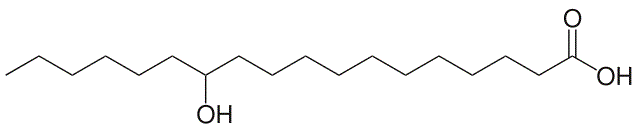
Why it is interesting: While coventional rigid insulation foams are closed-celled, rigid foams for use in vacuum insulation panels (VIPs) need to have a very high open cell content together with a cell size which is as small as possible. The current invention relates to reactive cellopeners comprising a silicone ‘base’ oil and the metal salt of a fatty acid having a (isocyanate-reactive) hydroxy group.  In an example the Li-salt of of 12-hydroxystearic acid is produced from LiOH and the fatty acid using a silicone oil as reaction medium. The composition, having a 30% solids content, is then used as a cellopener in a rigid foam formulation resulting in a cell size of about 90μm and 98% open cell content at a density of about 50 kg/m³. A perfluoroalkane nucleating agent was used as well.

12-hydroxystearic acid

12-hydroxystearic acid


Polyurethane Dispersions with “Reversible Drying”

Title: RADIATION CURABLE AQUEOUS COMPOSITIONS WITH REVERSIBLE DRYING

 Number/Link: WO2014/111349

Applicant/Assignee: Allnex

Publication date: 24-07-2014

Gist”: PUDs from hydrophilic, low molecular weight PU can be re-dispersed after drying.

Why it is interesting: It is known that PUDs will coalesce into an insoluble film when dried, at least when the temperature is over the ‘minimum film forming temperature’ or MMFT.  This behaviour, while being useful in most coating- and adhesives applications, can be problematic when the PUDs are used for jet-printing inks because of irreverisble blocking of the print-head nozzles.  According to this invention re-dispersible PUDs can be made when the PU used is both sufficiently hydrophilic and of a low average molecular weight (pref. an Mn between 1000 and 5000, with a polydispersity between 2 and 4). The PU does need to be radiation curable so it can be crosslinked after drying.  In the examples a low NCO prepolymer is prepared from 1,6-hexanediisocyanate (HDI), 2,2-dimethylolpropionic acid, some polyester or polycarbonate polyol and an acrylic chainstopper like a propoxylated trimethylolpropane diacrylate. The (viscous) prepolymer is dispersed and neutralized by adding water containing NaOH or triethylamine. After drying the PUDs of the invention can be re-dispersed in water at 25°C.

Film-forming PU dispersion.

Film-forming PU dispersion.

  • Pages

  • Categories

  • Enter your email address to follow this blog and receive notifications of new posts by email.

    Join 259 other subscribers
  • Follow Innovation in PU on Twitter