Classic PU Patent of the Month: The First “HYPOL” Foams (1974).

Title: Dental and biomedical foams and method

 Number/Link: US3903232

Applicant/Assignee: W.R.Grace

Publication date: 2-09-1975

Gist”: A branched, low NCO prepolymer made from all-EO polyol and TDI or pMDI is reacted with a large surplus of water to make a new class of flexible foams.

Why it is interesting: HYPOL™-type foams are very soft, highly hydrophilic flexible foams which can be produced catalyst-free from a high EO prepolymer and a high surplus of water. Originally the prepolymers were based on all-EO triols or tetrols and TDI 80/20, or -alternatively-  PEGs and polymeric MDI. Later these systems were further improved by myself in 1991 using 75% EO triols and 4,4′ MDI. The (after drying) low- to medium density foams are very robust and versatile, can be compressed and restored by adding water, and the specific production process allows to add all kinds of functionalities via the water stream. The HYPOL trademark is currently owned by Dow Chemicals and may encompass a wider range of materials than original.
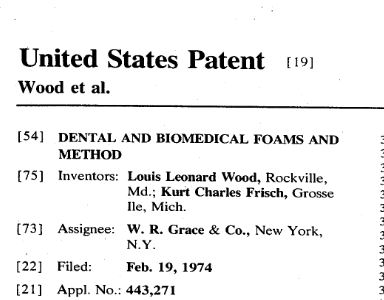
US3,903,232

US3,903,232

Classic PU Patent of the Month: The First Polyether Foams (1951)

Title: Verfahren zur Herstellung von Kunststoffen

 Number/Link: DE974371 (German)

Applicant/Assignee: Bayer AG

Publication date: 12-08-1960

Gist”: A prepolymer from a polyether polyol and an excess of isocyanate is reacted with water to produce an elastomeric  foam.

Why it is interesting: This patent specifies the first polyether prepolymers and polyether  foams as invented by Otto Bayer and co-workers.  In the examples an all-EO, 4000 MW triol, prepared from trimethylolpropane and  ethylene oxide is reacted with a surplus of TDI resulting in a 3.2% NCO prepolymer.  This prepolymer is reacted with water to form either elastomeric films or elastomeric (flexible) foams. There are only two claims, the first covering  polyether prepolymers, the second covering both “one-shot” and “full prepolymer” water-blown polyether foams:

PATENTANSPRÜCHE:

1. Verfahren zur Herstellung von Kunststoffen,
dadurch gekennzeichnet, daβ Polyglykolather mit
einem Molekulargewicht von mindestens 500 und
mindestens zwei endstandigen Hydroxylgruppen
mit einem Übersehuβ über die berechnete Menge
an polyfunktionellen aliphatischen oder aromatischen
Isocyanaten und die erhaltenen Polyglykolätherisocyanate
mit Verbindungen mit reaktionsfahigem Wasserstoff
umgesetzt werden.

2. Ausführungsform des Verfahrens nach Anspruch
1, insbesondere zur Herstellung von Schaumstoffen,
dadurch gekennzeichnet, daβ als Verbindung
mit reaktionsfahigem Wasserstoff Wasser verwendet
wird und die Umsetzung mit Wasser gleichzeitig
mit der oder anschlieβend an die Umsetzung
der Polyglykolather und polyfunktionellen
Isocyanate erfolgt.

Dr. Otto Bayer

Dr. Otto Bayer

Classic PU Patent of the Month: Otto Bayer’s Invention of Polyurethane and Polyurea (1937)

Title: Verfahren zur Herstellung von Polyurethanen bzw. Polyharnstoffen

Number/Link: DE728981  (German)

Applicant/Assignee: I.G.Farbenindustrie

Publication date: 12-11-1942

Gist”: Production of polyurethanes by reacting diisocyanates and compounds containing at least two hydroxyl and/or amine groups.

Why it is interesting: This is the patent that marked the start of the polyurethane industry.   It covers both aromatic and aliphatic diisocyanates, notably NDI, MDI, TDI, HDI etc. The examples cover polyurethane and polyurea fibers and films. It is said that Bayer was trying to copy Nylon 6,6, the structure of which is very similar to a PU based on 1,6 hexanediol and 1,6 hexanediisocyanate.  The patent has only one claim:

“PATENTANSPRUCH:
Verfahren zur Herstellung von Polyurethanen bzw. Polyharnstoffen, dadurch gekennzeichnet, daβ man organische Diisocyanate mit solchen organischen Verbindungen
zur Reaktion bringt, die mindestens 2 Hydroxyl- oder Aminogruppen mit austauschbaren Wasserstoffatomen oder mindestens eine Hydroxylgruppe und mindestens eine Aminogruppe ,der genannten Art enthalten.”

Dr. Otto Bayer (1902-1982)

Dr. Otto Bayer (1902-1982)

  • Pages

  • Categories

  • Enter your email address to follow this blog and receive notifications of new posts by email.

    Join 259 other subscribers
  • Follow Innovation in PU on Twitter