Aliphatic TPU with Reduced Effloresence

Patent Title: ALIPHATIC THERMOPLASTIC POLYURETHANES, PRODUCTION AND USE THEREOF

 Number/Link:   WO2018/192936 (German)

Applicant/Assignee:  Covestro

Publication date: 25 October 2018

Gist”: TPU based on 1,10-decanediisocyanate shows reduced blooming

Why it is interesting: Aliphatic thermoplastic polyurethanes, based on hexanediisocyanate (HDI) can show “blooming” i.e. the formation of a white precipitate on the surface of the material.  It is believed that this is caused by the formation of cyclic oligourethanes migrating to- and forming crystals on the surface. According to this invention, this blooming behaviour can be prevented by using long-chain aliphatic diisocyanates like 1,10-diisocyanatodecane or 1,12-diisocyanatododecane instead of HDI.

DDI

1,10-diisocyanatohexane (DDI)


Polyurethanes from Bisphenol-Based Polyols

Patent Title:  OLIGOMERIC POLYOL COMPOSITIONS

 Number/Link:WO2018/190891

Applicant/Assignee:  Presidium USA

Publication date: 18 October 2018
Gist”: Polyurethanes from high functionality  bisphenol-based polyols

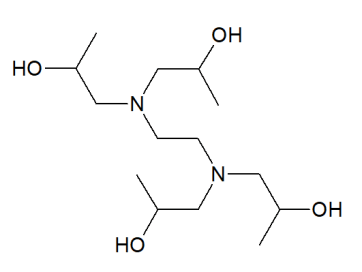
Why it is interesting: The invention relates to high functionality (and high viscosity) polyols that consist of bisphenol moieties and aliphatic polyol moieties and that can be prepared by reacting a bisphenol-based polycarbonate with a short-chain, high functionality polyol in the presence of a suitable catalyst or promotor.  In the examples a bisphenol-A based polycarbonate powder is reacted with propoxylated pentaerythritol and a tetra – OH – functional tert-amine that acts as a promotor.  The polyols are said to be useful for high stiffness polyurethanes that show improved heat distortion and a relatively low reaction exotherm.

multranol

Catalytic tetrol used in the invention


TPU Nanocomposite

Patent Title: POLYURETHANE COMPOSITE

 Number/Link: WO2018/185650 (Spanish)

Applicant/Assignee: UNIVERSIDAD DE ANTIOQUIA

Publication date: 11 October 2018

Gist”: Protein-stabilized nano- calciumcarbonate particles are incorporated into a thermoplastic polyurethane composition

Why it is interesting: Calciumcarbonate nanoparticles are prepared by mixing a solution of sodium carbonate, sodium caseinate and calciumchloride in a high pressure homogenizer. Particles are formed of CaCO3 embedded in a protein matrix that stabilizes that particles against aggregation. Particle size is (pref) 150-300nm with primary CaCO3 particles of 5-10nm. The particles are used in an amount of (pref) 0.6-1% (w/w) on a TPU composition. The TPUs are said to show increased mechanical properties and improved cell growth and are said to be useful for biomedical applications.

nanoparticle

Stabilized nanoparticles (Wikipedia)

  • Pages

  • Categories

  • Enter your email address to follow this blog and receive notifications of new posts by email.

    Join 259 other subscribers