SHSM Polyurethanes

Title: SHAPE-MEMORY-SELF-HEALING POLYMERS (SMSHPS)

 Number/Link: WO2015119688

Applicant/Assignee: University of Florida

Publication date: 13-08-2015

Gist”: Self-healing shape memory polyurethanes made by incorporation of DA adducts in-chain

Why it is interesting: According to this invention self-healing shape memory polyurethanes can be prepared by incorporating Diels-Alder (DA) adducts into the PU network such that the DA adducts do not contribute to the crosslinking.  In this manner the material can be heated above Tg without breaking crosslinks thereby inhibiting permanent distortion of the memorised shape. The Tg is also chosen such that it is lower than the temperature at which the retro-DA reaction readily occurs. The DA adducts can be introduced using a DA adduct-containing diol as for example the adduct of a furfuryl alcohol and N-(2-hydroxyethyl)maleimide.  The SHSM polyurethanes are said to be useful for coatings and moulded materials.

Diol containing a Diels-Alder adduct
Diol containing a Diels-Alder adduct

Classic PU patent of the Month: PORON ® Foams (1979)

Title: Polyurethane foam product and process of manufacture thereof from thermosetting frothed mixture

 Number/Link: US4216177

Applicant/Assignee: Rogers

Publication date: 5-08-1980

Gist”: Frothed flexible foam

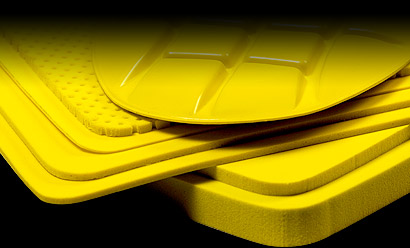
Why it is interesting: PORON is a popular brand of microcellular elastomeric/flexible polyurethane foams produced by Rogers Corporation. The original process, as documented in this patent, is quite simple:  a flexible foam formulation (in the examples) based on TDI, caprolacton diol, polymer polyol, some chain extender, amine catalyst and surfactant is frothed instead of blown with water or a physical blowing agent. The reacting froth is poured on release paper and heated to cure. Release paper can also be applied on top resulting in an integral skin on both sides of the layer. Frothing instead of blowing results in an improved compression set, different hardness-density relationship and a better control over cell structure. A unique material.

PORON foams

PORON foams

PU Rigid Foams with very Small Cell Size

Title: RIGID POLYURETHANE FOAM HAVING A SMALL CELL SIZE

 Number/Link: WO2015/109488

Applicant/Assignee: Dow

Publication date: 30-07-2015

Gist”: Rigid foams are blown with CO2 under pressure

Why it is interesting: It is known that the thermal conductivity of conventional rigid polyurethane foams can be most efficiently improved by reducing the conductivity contribution of the gas present in the foam cells. This, in turn, can be achieved by reducing the gas pressure, by using ‘heavy’ blowing agents or by reducing the average cell size.  The current application discloses rigid PU foams having cell sizes small enough to achieve a thermal conductivity of less than 16 mW/m.K without the need for a strong vacuum or special blowing agents. This is achieved by first saturating the polyol formulation with CO2 under pressure, then adding the isocyanate and increasing the pressure for a set amount of time and finally releasing the pressure to allow the material to expand. Examples are given using a pressure of 7 MPa at 40°C for 30 minutes to saturate the polyol, and a pressure of 10 MPa for up to about 10 minutes after addition of the isocyanate.  Foams with average cell sizes of 8 to 70 μm and porosities of up to 90% are obtained at densities of about 250 to about 300 kg/m³.  Oddly enough no thermal conductivity (λ) values are given.

Rigid polyurethane insulation foams (Wikimedia)

Rigid polyurethane insulation foams (Wikimedia)


  • Pages

  • Categories

  • Enter your email address to follow this blog and receive notifications of new posts by email.

    Join 259 other subscribers