Non-Isocyanate Poly(Amide-Hydroxyurethanes)

Patent Title: NON-ISOCYANATE POLYURETHANES AND METHODS OF MAKING AND USING THE SAME

 Number/Link: WO 2017/ 030880

Applicant/Assignee: ELEVANCE RENEWABLE SCIENCES

Publication date: 23-feb-2017

Gist”: Telechelic cyclocarbonate-alkylesters are reacted with diamines in the melt

Why it is interesting: According to this invention (ω-) unsaturated alkylesters can be converted to mono-cyclocarbonate alkylesters and then reacted with diamines to prepare thermoplastic poly(amide-hydroxyurethanes) (PAHU). For example methyl-9-decenoate was first epoxidized and then reacted with CO2 to produce 9,10-cyclic carbonate-methyl decanoate. After separation and washing the cyclocarbonate was reacted – in the melt- with a mixture of dodecane diamine and a PTMO diamine (Jeffamine THF-100). It is said that the unsaturated alkylesters can be prepared from natural oils using (cross- or self-) metathesis followed (or preceded) by transesterifaction with alkanols.

PAHU preparation scheme
PAHU preparation scheme

TPU from Gem-Dialkyl Cyclooctene

Patent Title: TELECHELIC PREPOLYMERS AND REACTION PRODUCTS THEREOF

 Number/Link: WO 2017/023506

Applicant/Assignee: University of Minnesota

Publication date: 9-feb-2017

Gist”:  Diols are made by ROM polymerization of gem-dialkyl cyclooctene together with a symmetrical diol as chain transfer agent

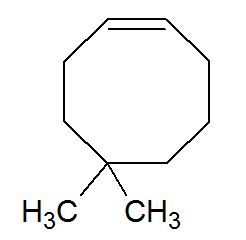
Why it is interesting: According to this application, thermoplastic polyurethanes containing geminal dialkyl groups have far superior thermal stability, oxidative-, hydrolytic- and barrier properties as compared to TPUs containing conventional soft segments. Diols containing gem-dialkyl groups are prepared by ring-opening metathesis polymerization (ROMP) of a gem-dialkyl cyclooctene with a suitable catalyst and in the presence of a symmetrical aliphatic olefin chain transfer agent having functional end groups. Examples are 5,5-dimethylcyclooct-1-ene and 1,8-oct-4-ene diol as the chain transfer agent.  The resulting diol is then reacted with (e.g.) 4.4′-MDI to prepare the TPU.

5,5-dimethylcyclooct-1-ene

5,5-dimethylcyclooct-1-ene

Hydrolysis Resistant Polyester Urethane

Patent Title: HIGHLY DURABLE POLYESTER POLYOL

 Number/Link: US2017/0022143

Applicant/Assignee: Kuraray

Publication date: 26-jan-2017

Gist”: PU from polyester polyol with bulky side groups

Why it is interesting: The invention is about polyester polyols prepared from a dibasic acid (e.g adipic acid) and a mixture of two diols: 3-methyl-1,5-pentanediol and cyclohexane-1,1-dimethanol. The diols are used in a molar ratio of about 1:1 (25-75 to 75-25 pref.). Polyurethanes prepared with these polyesters are said to be highly hydrolysis resistant in both acidic and basic environments.

Cyclohexane-1,1-dimethanol

Cyclohexane-1,1-dimethanol

  • Pages

  • Categories

  • Enter your email address to follow this blog and receive notifications of new posts by email.

    Join 259 other subscribers
  • Follow Innovation in PU on Twitter