Self-Cleaning Coating… or not?

Title: SELF-RENEWING HYDROPHILIC ORGANIC COATINGS

 Number/Link: US2014/018466

Applicant/Assignee: Empire Technology

Publication date: 16-01-2014

Gist”: Coating containing free amine groups resulting in a hydrophilic surface that is supposedly self-cleaning.

Why it is interesting: Conventionally “self-cleaning” surfaces are produced using hydrophobic coating compositions resulting in surfaces with low contact angles with respect to water.  The current case claims that highly hydrophilic surfaces also show a self-cleaning effect.  An emulsion-polymerized polymer with blocked-isocyanate side groups is used as a coating composition.  After the coating is applied the side groups are deblocked by atmospheric moisture resulting in (hydrophilic) amine groups.  In an example 2-methyl-acrylic acid 2-isocyanatoethyl ester blocked with 3,5-dimethylpyrazole was emulsion polymerized and, together with additives, used as a coating composition.
While this is fun chemistry I very much doubt that this coating would be truly self-cleaning.  The amine groups will surely react with all kinds of stuff in the air possibly resulting in quite the opposite.
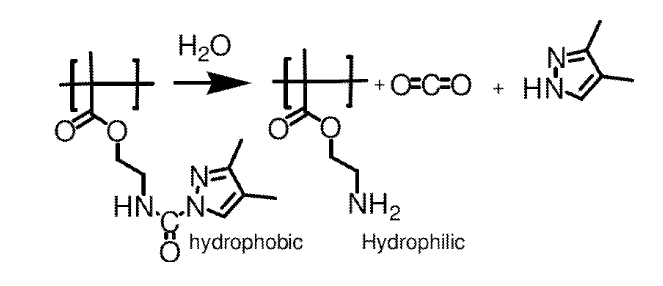
deblocking of the isocyanate side groups under the influence of water.

deblocking of the isocyanate side groups under the influence of water.

Flexible Foams containing Polyurethane Phase Change Gels

Title: Polyurethane Gel-Like Polymers, Methods and Use in Flexible Foams  

 Number/Link: US2013/0296449

Applicant/Assignee: PETERSON CHEMICAL TECHNOLOGY

Publication date: 07-11-2013

Gist”:   “Polyurethane phase change gels” prepared from polyurethane gels and conventional PCMs are incorporated into polyurethane or latex flexible foams to improve thermal comfort.

Why it is interesting: This application is closely related to the application discussed in the previous post but instead of a plasticized styrenic triblock copolymer, now a polyurethane gel is used. The PU gel is produced from conventional raw materials at low NCO-index (about 60%) together with plasticizers.

A Polyurethane Gel

A Polyurethane Gel

Incorporating “Phase Change Gels” into Flexible Foams for Improved Thermal Comfort

Title: Thermal Storage Gelatinous Triblock Copolymer Elastomer Particles in Polyurethane Flexible Foams

 Number/Link: US2013/295371

Applicant/Assignee: PETERSON CHEMICAL TECHNOLOGY

Publication date: 07-11-2013

Gist”:  Particles of  “phase change gels” prepared from plasticized styrenic TPEs and conventional PCMs are incorporated into polyurethane or latex flexible foams

Why it is interesting: A conventional phase change material (PCM) selected from alkanes, PEGs, hydrated salts ect. with a transition temperature between 20 and 35°C is melt-blended with a plasticized styrenic triblock copolymer like SBS, SIS, SEBS etc. to form a “phase change gel”. The gel is then comminuted and added to a flexible foam forming composition in an amount of about 30 pphp. The resulting foams have an increased thermal conductivity which together with the temperature buffering properties of the PCM improves thermal comfort. The flexible foams are useful in application such as matresses, pillows, automotive cushioning, shoe inserts, medical foams and the like. In my opinion especially useful for viscoleastic (“memory”) foams which are known to suffer from thermal discomfort problems.

Effect of "gel PCM" on heating rate of flexible foam according to the invention.

Effect of “gel PCM” on heating rate of flexible foam according to the invention.

  • Pages

  • Categories

  • Enter your email address to follow this blog and receive notifications of new posts by email.

    Join 259 other subscribers
  • Follow Innovation in PU on Twitter