Soft, High Resilience Polyurethane Elastomers

Title: URETHANE FOAM RUBBER AND COMPOSITION FOR FORMING URETHANE FOAM RUBBER

 Number/Link: US20150105485

Applicant/Assignee: Yamaha

Publication date: 16-04-2015

Gist”: Use of carbodiimide-MDI to make soft high resilience elastomers

Why it is interesting: According to this patent application, soft, high-resilient PU elastomers with a density higher than 300 kg/m³ can be prepared from a diisocyanate, a polyether polyol with a molecular weight of about 1000 to 4000 together with some polymeric MDI. The invention being, that the diisocyanate needs to have an “atom number minimum bond path” between the two NCO groups of at least 11.  Examples of such diisocyanates would be α,ω-undecane- (or dodecane- or tridecane- etc.) diisocyanates, propylene-1,3-di(1,4-cyclohexylene diisocyanate) but also carbodiimide modified MDI which is preferred. Examples are given of 440 kg/m³ elastomers with a ball rebound of 81 and an Asker C hardness of 44 at temperatures ranging from -20°C to 50°C,  based on a polyTHF diol with a MW of 2000 and a carbodiimide modified MDI.  No other isocyanates are used in the examples, so it appears to me that the “atom number minimum bond path” is just an attempt to make this case new and patentable. Not very convincing. I would like to see an example with tridecanediisocyanate.

Carbodiimide modified MDI

Carbodiimide modified MDI species


TPU from Low Free Monomeric Isocyanate Prepolymers

Title: THERMOPLASTIC POLYURETHANE FROM LOW FREE MONOMER PREPOLYMER

 Number/Link: WO2014/186111

Applicant/Assignee: Chemtura

Publication date: 20-11-2014

Gist”: TPUs with exceptional properties are produced from “full” prepolymers with a very low free monomeric isocyanate content.

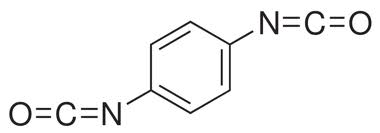
Why it is interesting: According to this invention thermoplastic polyurethanes with improved processing characteristics and with exceptional mechanical-, fatigue- and ageing properties can be produced by reacting a ‘full’ prepolymer having a low ( less than 0.5% ) free monomeric isocyanate content with a low molecular weight chain extender. PPDI and MDI prepolymers with low free monomeric isocyanate can be prepared e.g. by distillation of the prepolymer in the presence of a inert solvent with a boiling point slightly lower than the monomeric diisocyanate present (see e.g. US2009/0076239). Products like this are commerically available. The reason for the exceptional properties is undoubtedly the result of a very regular microphase structure of these TPUs.

para-phenylenediisocyanate (PPDI)

para-phenylenediisocyanate (PPDI)

Using PU Foams as a Template for Silicone Foams

Title: FOAM-LIKE MATERIALS AND METHODS FOR PRODUCING SAME

 Number/Link:US2014/154491

Applicant/Assignee: Allergan

Publication date: 5-06-2014 (priority PCT/US)

Gist”: A polyurethane foam is impregnated with a curable liquid silicone.  After curing of the silicone the PU is removed.

Why it is interesting: According to this invention open celled polyurethane (or melamine) foam structures can be ‘converted’ into other materials like silicone, polyesters, polyolefins etc. by impregnating them with the the appropriate raw materials, curing and removing the ‘base’ foam. Optionally the ‘converted’ foam structure can be impregnated and cured again until the desired porosity is obtained.  In an example a PU foam was impregnated with a HTV silicone rubber.  After curing, the PU structure was removed using hydrogen peroxide.
While undoubtedly very interesting foam materials can be made in this way, the process seems messy and not very practical.

A 'base foam structure' (left has been impregnated and cured with another polymer (right).

A ‘base’ foam (left) and an impregnated foam (right) according to the invention.


  • Pages

  • Categories

  • Enter your email address to follow this blog and receive notifications of new posts by email.

    Join 259 other subscribers
  • Follow Innovation in PU on Twitter