PIPA Polyol Made From “Conventional” Polyol

Title: PROCESS FOR THE PREPARATION OF A POLYOL COMPOSITION

 Number/Link: WO2014/037558

Applicant/Assignee: SHELL

Publication date: 13-03-2014

Gist”: A PIPA polyol is made from TDI,  TELA and a high sec-OH polyol which is added in two stages.

Why it is interesting: PIPA polyols are a class of ‘filled’ polyols containing dispersed polyurethane particles and are often used in flexible foams to improve hardness and air flow. These polyols are usually produced by dispersing an olamine, like triethanolamine (TELA), in an EO-tipped EO/PO polyether polyol and reacting it with isocyanate under mixing.  Producing PIPA polyols from a high secondary-OH containing (“conventional”) polyol, i.e. an all- PO or EO/PO random polyol would have cost advantages but -according to SHELL- results in an unstable polyol which produces closed-celled flexible foam. The trick they invented to solve this problem is to produce the particle dispersion from TELA and TDI in about 50% of the total amount of polyol used and adding the remainder of the polyol in a second step.  Remarkably this simple trick appears to be new and patentable.
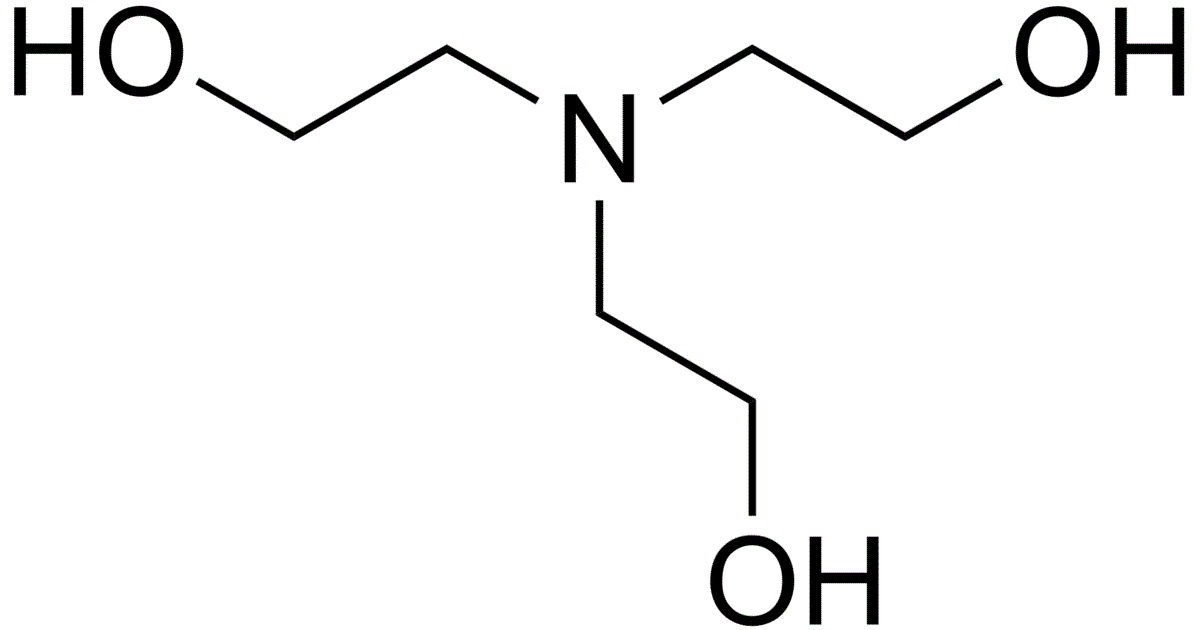
Triethanolamine

Triethanolamine

Polyurea ‘Nano’-Particles to Improve Properties of Polyurethane Flexible Foams and Elastomers

Title: USE OF POLYUREA NANOPARTICLES AS PERFORMANCE MODIFIERS IN POLYURETHANE MATERIALS

 Number/Link: WO2014/012769

Applicant/Assignee: Huntsman

Publication date: 23-01-2014

Gist”: A dispersion of polyurea particles prepared from 4,4′ MDI, diamine chain extender and a high mole weight monoamine is used to improve mechanical properties of flex foam.

Why it is interesting: Dispersions of polyurea particles with an average diameter of a few hundred nanometer and a Tg>150°C (pref.) can be produced by first reacting a relatively high MW polyether monoamine and a di-isocyanate (optionally dispersed in e.g. polyol) and subsequently adding a diamine chain extender. The dispersion is then used in a flexible foam or elastomer formulation, such that the amount of particles in the material is about 1-5% (w/w). In an example a 2000MW EO/PO monoamine was used together with 4,4′-MDI and a diamine chain extender to produce a particle dispersion in polyol, which was then used in polyurethane formulations. The particles do seem to have a positive effect on mechanical properties, however, the results for flex foam are clouded because of a sharp increase in material density compared to the reference. This density increase may well be due to a cellopening effect as described in WO2007/104623  in which a similar particle dispersion is used.

Polyethermonoamine as used in the invention.

Polyethermonoamine as used in the invention.

Reducing aldehyde emissions from flexible foams

Title: POLYURETHANE FOAMS WITH DECREASED ALDEHYDE EMISSIONS, A PROCESS FOR PREPARING THESE FOAMS AND A METHOD FOR DECREASING ALDEHYDE EMISSIONS IN POLYURETHANE FOAMS

 Number/Link: WO2013116092

Applicant/Assignee: Bayer

Publication date: 8-08-2013

Gist”: Use of small amounts of hexamethylenediisocyanate trimer or small amounts of “PHD” polyols result in reduced aldehyde emissions from flex foams.

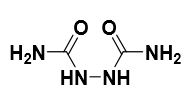
Why it is interesting: Reduction of VOC emissions and especially emissions of formaldehyde and acetaldehyde are an important issue for the polyurethane flexible foam industry, especially for bedding and automotive applications. This invention teaches two “tricks” to help solve the problem.  To a (preferably) TDI-based flex foam formulation which comprises at least one SAN or PIPA filled polyol, 0.5-3 pbw of trimerized hexamethylene diisocyanate is added on 100 pbw of the isocyanate.  Alternatively 2-3 pbw of PHD polyol is added on 100 pbw of the iso-reactive component. In the art “PHD polyol” usually stands for a polyurea ‘filled’ polyol (polyharnstoff dispersion), but in this case it stands for polyhydrazodicarnbonamide filled polyols. These PHD polyols are prepared by reacting a hydrazine with an isocyanate (pref TDI80) in a base polyol, so they are actually a subset of ‘conventional’ PHD dispersions.  The patent application is a bit confusing in this respect.

Hydroazodicarbonamide

Hydrazodicarbonamide

  • Pages

  • Categories

  • Enter your email address to follow this blog and receive notifications of new posts by email.

    Join 259 other subscribers
  • Follow Innovation in PU on Twitter