Polymer Polyols with Phosphorous-Containing Particles

Title: PHOSPHOROUS BASED POLYADDITION/POLYURETHANE-UREA POLYOLS

 Patent Number & Link: WO2013101524

Applicant/Assignee: Dow

Publication date: 4-07-2013

Gist”: PHD and PIPA polyols are produced in the presence of phosphorous containing polyols

Why it is interesting: PDH or PIPA polymer polyols can be prepared by dissolving a low MW amine- or  hydroxyl containing co-reactant in a ‘base polyol’ and subsequently reacting with an isocyanate. When executed properly and with the correct ingredients this results in a stable dispersion of respectively urea or urethane particles in the base polyol. (see also previous posts in this blog). This invention states that by using phosphorous flame retardants containing amine or hydroxyl groups in addition to the co-reactant, PIPA or PHD (or hybrid) polymer polyols can be prepared with flame the retardant incorporated in the particles, resulting in a flame retardant polymer polyol.
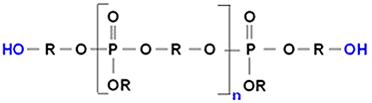
Phosphorous polyol as used in the invention

Phosphorous polyol as used in the invention

Hybrid Polymer Polyols

Title: HYBRID PHD/PMPO POLYOLS FOR POLYURETHANE FOAM APPLICATIONS

 Number/Link: WO2013090325 (=US20130158142)

Applicant/Assignee: Bayer

Publication date: 20-06-2013

Gist”: A hybrid SAN-PHD filled polyol allows for higher solids content and lower viscosity.

Why it is interesting: “Filled polyols” (i.e. polyols containing dispersed particles) are well known in polyurethane technology and are available in three types depending on the type of particles dispersed. “PIPA” polyols contain polyurethane particles, “PHD” polyols contain polyurea (“polyharnstoff”) particles and “polymer polyols” contain SAN (styrene-acrylonitrile) particles. The polyol in which the particles are dispersed is called the ‘base polyol’. The current invention teaches the preparation of a hybrid filled polyol by using PIPA or PHD polyol as (optionally part of) the base polyol to produce a SAN polymer polyol. The hybrid polymer polyol reportedly has has a lower viscosity at higher solids content and foams produced with it are claimed to have improved fire and VOC properties.

SAN

SAN

Polymer Polyols Based on Castor Oil

Title: GRAFT POLYOL AND METHOD OF FORMING THE SAME

 Number/Link: WO2013/039907

Applicant/Assignee: BASF

Publication date: 21-03-2013

Gist”: Castor oil containing up to about 60% w/w modified SAN particles.

Why it is interesting: Castor oil is the only (commonly) occuring natural oil polyol (NOP).  Other natural oils need modifications which introduce isocyanate-reactive groups,  increasing their viscosity and therefore making them less useful to turn into “grafted” or polymer polyols.  In this invention styrene and acrylonitrile are copolymerised in castor oil together with a chain transfer agent and an ethylenically unsaturated ‘macromer polyol’. The macromer polyol is preferably a sorbitol-started EO/PO polyol with a molecular weight of about 6000 which is subsequently reacted with an unsaturated alifatic isocyanate. The macromer polyol sterically stabilizes the SAN particles and allows for high solid contents (up to 60% in the examples) at a reasonable viscosity. Polymer polyols are especially useful in flexible foam formulations.

Main Component of Castor Oil

Main Component of Castor Oil

  • Pages

  • Categories

  • Enter your email address to follow this blog and receive notifications of new posts by email.

    Join 259 other subscribers
  • Follow Innovation in PU on Twitter