TPU Shrink Wrap

Title: TPU SHRINK MATERIAL

Number/Link: WO2017/108920

Applicant/Assignee: BASF

Publication Date: 29-jun-2017

“Gist”: Shape memory TPU is used as shrink wrap

Why it is interesting: A thermoplastic polyurethane with a shape-memory is prepared from a diisocyanate, a chain extender and a polyol comprising an ‘aromatic polyester block’, especially a polyethylenetherephthalate block. The composition is chosen such that the TPU has a melting point between 160 and 230ºC and another phase transition between 30 and 80ºC (the “switching temperature”). Films of this material are then stretched at a temperature higher than the switching temperature but below melt temperature and then cooled in stretched state. The stretched films are said to be useful as shrink wrap, especially for foodstuffs. No examples are given.
A surprising application for TPU but hardly a surprising TPU invention i.m.o.
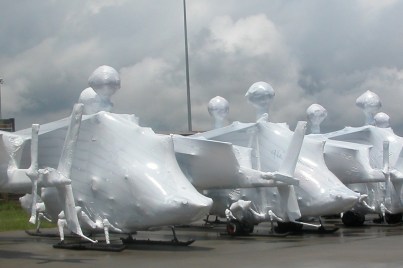
Shrink-wrapped Helicopters (Wikipedia)


Crystalline High-Hardblock TPU

Title: CRYSTALLINE HIGH MODULUS THERMOPLASTIC POLYURETHANE

Number/LinkWO2017079101  WO2017079188

Applicant/Assignee: Lubrizol

Publication Date: 11 May 2017

“Gist”: High-hardblock TPU using ‘stacking’ chain extenders and MDI

Why it is interesting: Thermoplastic polyurethanes with hardblock levels of 75% and higher were first patented by Upjohn in 1981 in a “classic” patent which has been discussed before in this blog. These materials – often marketed under the ‘ISOPLAST’ tradename- are usually produced from a diol, 4,4′-MDI and a (mixture of) chain extender(s) comprising a ‘non-stacking’ chain extender like cyclohexanedimethylol, neopentylglycol, MPdiol etc. to control crystallinity. In the current invention only ‘stacking’ chain extenders are used in an otherwise identical composition, resulting -unsurprisingly- in a more crystalline material with a higher modulus and melting temperature. It is also said that these materials are easier to compound with e.g. fire retardants.
Even if this idea were formally ‘new’ I doubt its inventiveness and therefore its patentability.

The famous ISOPLAST(TM) nail

Matte, Self-Healing Polyurethane Powder Coatings

Title: POLYURETHANE COATING COMPOSITION

Number/Link: WO2017/074835

Applicant/Assignee: Valspar

Publication Date: 4 May 2017

“Gist”: Coating composition comprising isocyanate and two polyester polyols having a similar Tg but a widely different equivalent weight.

Why it is interesting: Conventionally low gloss or “matte” coatings are the result of a microtextured surface achieved by certain fillers or by incompatible polymers and the like. According to this invention “ultra matte” finishes can also -surprisingly- be achieved from a (powder) coating composition comprising a (blocked) isocyanate and a mixture of two polyester polyols. Both polyols have a Tg between 40 and 60ºC prefereably differing not more than 5 to 8ºC, while the OHv of the first polyol is between 150 and 325 and that of the second between 15 and 35.  The ratio between first and second polyol is from about 1:1 to 1:3 w/w. Also surprisingly, the resulting coatings are said to show self-healing properties. An interesting composition but no examples of the polyesters or isocyanates used are given.

Car with matte finish

  • Pages

  • Categories

  • Enter your email address to follow this blog and receive notifications of new posts by email.

    Join 259 other subscribers
  • Follow Innovation in PU on Twitter