Renewable Polyurea from Lysinol

Title: NEW POLYMERS DERIVED FROM RENEWABLY RESOURCED LYSINOL

 Number/Link: US2014/275311

Applicant/Assignee: Du Pont

Publication date: 18-09-2014

Gist”: Use of lysinol as renewable monomer for nitrogen-containing polymers including polyurea.

Why it is interesting: Lysinol or 2,5-diamino-1-hexanol is an amino alcohol derived from the amino acid lysine by  hydrogenation.  Lysine itself is produced by fermentation from sugars.  Annual production of lysine is apparently in excess of 1 million tonnes and its derivative lysinol is therefore considered as a potentially interesting biorenenawable monomer for a number of nitrogen-containing polymers. This patent application claims lysinol-based polyamides, polyimides, polyureas and “urethane crosslinked” polyureas including foams. In the examples urethane-polyureas are produced by reacting lysinol with hexamethylenediisocyanate using DABCO as catalyst.

Preparation of the two lysionol enantiomers from lysine.

Preparation of the two lysinol enantiomers from lysine.
Bio-Renewable Thermoplastic Polyurethanes

Title: HOMOGENEOUS EXTRUDED ARTICLES MADE FROM THERMOPLASTICALLY PROCESSABLE POLYURETHANES BASED ON POLYESTER DIOLS FORMED FROM SUCCINIC ACID AND 1,3-PROPANEDIOL

 Number/Link: US2014/0256902

Applicant/Assignee: Bayer

Publication date: 11-09-2014 (priority PCT)

Gist”: TPU based on polyester diols prepared from succinic acid and propandiol

Why it is interesting: The use of biorenewable raw materials is no longer a curiosity in polyurethane production. Especially natural oil-based polyols are currently fashionable in newly developed products.  These ‘NOPs’ are however not very suitable for the production of thermoplastic polyurethanes.  According to the current invention (partly) bio-renewable TPUs can be produced from polyester diols based on succinic acid and 1,3-propanediol. Both these monomers can be produced by fermentation of carbohydrates. 1,3-propanediol is produced on industrial scale by DuPont through fermentation of corn syrup using genetically modified E.Coli bacteria (“Bio-PDO”). In the examples PDO-succinate polyester diols with MW from 1000 to 2000 are used together with 4,4′-MDI and 1,4-butanediol to produce TPUs with shore hardness ranging from 85 to 94A and Tg’s from -18 to +11°C.

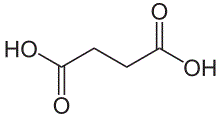
Succinic acid or butanedioic acid.

Succinic acid or butanedioic acid.

Classic PU Patent of the Month: ICI on Non-Isocyanate Polyurethanes (1961)

Title: Polyurethanes

 Number/Link: GB944310

Applicant/Assignee: Imperial Chemical Industries

Publication date: 11-12-1963

Gist”: Non-isocyanate polyurethanes by transurethanization of bis-carbamates and polyols.

Why it is interesting: Because of the growing concern over isocyanate toxicity and related changes in legislation, research and development of non-isocyanate polyurethane (NIPU) systems has increased sharply over the last few years. The idea, and most of the chemistry of NIPU is by no means new. In this patent, filed by ICI in 1961, NIPU is prepared by transesterification of bis-carbamates and polyols with a functionality of 2 or more. The materials are said to be especially useful for coatings and as TPU for fiber production. According to the patent, the advantages of this reaction system over the use of isocyanates are the reduction of the toxicity hazard, less moisture sensitivity and no need to carefully control reaction conditions and reactant proportions.  In an example N,N’-methylene-bis-urethane was reacted with 1,4-butanediol catalyzed by DBTDL resulting in a TPU which could be melt-drawn into fibers.  (Note that, in this case, ‘urethane’ is the common name for ethylcarbamate).

ICI logo anno 1961.

ICI logo anno 1961

  • Pages

  • Categories

  • Enter your email address to follow this blog and receive notifications of new posts by email.

    Join 259 other subscribers
  • Follow Innovation in PU on Twitter