TPU from Low Free Monomeric Isocyanate Prepolymers

Title: THERMOPLASTIC POLYURETHANE FROM LOW FREE MONOMER PREPOLYMER

 Number/Link: WO2014/186111

Applicant/Assignee: Chemtura

Publication date: 20-11-2014

Gist”: TPUs with exceptional properties are produced from “full” prepolymers with a very low free monomeric isocyanate content.

Why it is interesting: According to this invention thermoplastic polyurethanes with improved processing characteristics and with exceptional mechanical-, fatigue- and ageing properties can be produced by reacting a ‘full’ prepolymer having a low ( less than 0.5% ) free monomeric isocyanate content with a low molecular weight chain extender. PPDI and MDI prepolymers with low free monomeric isocyanate can be prepared e.g. by distillation of the prepolymer in the presence of a inert solvent with a boiling point slightly lower than the monomeric diisocyanate present (see e.g. US2009/0076239). Products like this are commerically available. The reason for the exceptional properties is undoubtedly the result of a very regular microphase structure of these TPUs.
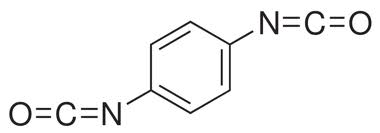
para-phenylenediisocyanate (PPDI)

para-phenylenediisocyanate (PPDI)

Poly (Urethane-Urea) Elastomers from High 2,6-TDI

Title: Polyurethane Elastomers Based on TDI Prepolymers Enriched in the 2,6-TDI Isomer Cured with Trimethylene Glycol Di-(para Amino Benzoate)

 Number/Link: US2014/0309397

Applicant/Assignee: Anderson Development

Publication date: 16-10-2014

Gist”: Elastomers are prepared from TDI containing a high amount of the 2,6 isomer.

Why it is interesting: Commercially available toluene diisocyanate (TDI) usually comes in the 80/20 or the 65/35  2,4/2,6 isomer blend. It is known that higher 2,6 levels result in stiffer hardblocks and a different reaction profile because of the (initially) equal reactivity of the isocyanate groups. According to this invention elastomers prepared from TDI with a 2,6 content of (most preferred) at least 60% results in superior green strength and dimensional stability. High 2,6 TDI-PTMEG prepolymers cured with trimethylene glycol di(p-aminobenzoate) (TGDBA) should even have a superior tear strength and upper hardness limit compared to MDI based elastomers.

TGDBA

TGDBA

Polyester Polyol with PDMS Backbone

Title: POLYESTER POLYOL, POLYURETHANE OBTAINED USING THE SAME, PROCESS FOR PRODUCTION THEREOF, AND MOLDED POLYURETHANE

 Number/Link: US2014/0246621

Applicant/Assignee: Mitsubishi Chemical

Publication date: 4-09-2014 (priority PCT)

Gist”: A polyester polyol is prepared from a caboxylic acid-modified PDMS and a polyether diol.

Why it is interesting: A polyester polyol is prepared form a linear polydimethylsiloxane end-capped with carboxylic acid groups and having a molecular weight between about 500 and 4000 together with a polytetramethyleneether glycol with MW of 500 to 2000, such that the PDMS content is about 40% . The use of this polyol in polyurethane elastomers results in modified surface characteristics like reduced tackiness. The invention mentions fibers and films as potential applications, but this could be an interesting polyol for many other applications as well. Interesting idea but probably not new.  Only one claim appears to have survived the filing process.


Representation of the polyester polyol according to the invention

Representation of the polyester polyol according to the invention

  • Pages

  • Categories

  • Enter your email address to follow this blog and receive notifications of new posts by email.

    Join 259 other subscribers
  • Follow Innovation in PU on Twitter