Polymer Polyols with Phosphorous-Containing Particles

Title: PHOSPHOROUS BASED POLYADDITION/POLYURETHANE-UREA POLYOLS

 Patent Number & Link: WO2013101524

Applicant/Assignee: Dow

Publication date: 4-07-2013

Gist”: PHD and PIPA polyols are produced in the presence of phosphorous containing polyols

Why it is interesting: PDH or PIPA polymer polyols can be prepared by dissolving a low MW amine- or  hydroxyl containing co-reactant in a ‘base polyol’ and subsequently reacting with an isocyanate. When executed properly and with the correct ingredients this results in a stable dispersion of respectively urea or urethane particles in the base polyol. (see also previous posts in this blog). This invention states that by using phosphorous flame retardants containing amine or hydroxyl groups in addition to the co-reactant, PIPA or PHD (or hybrid) polymer polyols can be prepared with flame the retardant incorporated in the particles, resulting in a flame retardant polymer polyol.
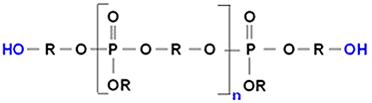
Phosphorous polyol as used in the invention

Phosphorous polyol as used in the invention

Yet Another Way to Make Isocyanate Prepolymers with Low Free Monomeric Isocyanate

Title: LOW-VISCOSITY REACTIVE POLYURETHANE COMPOUNDS

 Number/Link: WO2013092564 (in German)

Applicant/Assignee: Bayer

Publication date: 27-06-2013

Gist”: A prepolymer with very low free diisocyanate content and relatively low viscosity can be prepared by reacting MDI having a high 2,4′ isomer content with a low MW diol in a first step and adding a high MW polyol in a second step.

Why it is interesting: The use of asymmetric diisocyanates (having isocyanate groups with different reactivities) to prepare prepolymers with low free monomers is well known.  Prepolymers prepared using diisocyanates with high levels of 2,4′-MDI, 2,4-TDI, IPDI etc. will however still show a very high viscosity at low isocyanate content. Bayer has now found that prepolymers with lower free monomer and lower viscosity can be prepared by using two polyols reacted in seperate stages. In a first step an MDI with >95% 2,4′ isomer is reacted with a (pref) diol with a molecular weight between 60 and 700 to produce a prepolymer with an NCO content of more than 15%. In a second step this prepolymer is then further reacted with a ‘conventional’polyol to obtain the final prepolymer.  In an example a prepolymer with less than 0.1% free MDI and a viscosity of 25 Pa.s at 40°C was prepared.

2,4'-MDI

2,4′-MDI

Flexible Polyurethane Foams for Thinner Car Seats

Title: CHEMICAL COMPOSITION FOR OBTAINING POLYURETHANE

 Number/Link: WO2013/050639 (Spanish)

Applicant/Assignee: CENTRO TECNOLÓGICO DE GRUPO COPO,

Publication date: 10-04-2012

Gist”: Use of 1,5-pentanediol in flexible foam formulations results in foams with correct comfort properties to allow for thinner car seats.

Why it is interesting: About 2 pphp of 1,5 pentanediol is used together with a  mixture of MDI monomers and a  conventional flexible foam formulation to produce a 55kg/m3 foam with supposedly the correct comfort properties (hardness, hystersis loss, vibration damping  etc.) for a thinner car seat.  While the use of chain extenders is rare in flexible foams, it may very well make sense in somewhat higher-density systems. The first claim of this application however covers much more than flexible foam and will most probably not get granted as such.

  • Pages

  • Categories

  • Enter your email address to follow this blog and receive notifications of new posts by email.

    Join 259 other subscribers
  • Follow Innovation in PU on Twitter