Thermal Engine Encapsulation with Polyurethane Foam

Title: THERMAL INSULATION OF AN INTERNAL COMBUSTION ENGINE

 Number/Link: WO2014/195153 (German)

Applicant/Assignee: BASF

Publication date: 11-12-2014

Gist”:  Engine parts are encapsulated in PU foam using moulds.

Why it is interesting: Encapsulating (part of) motor car engines with heat-insulating rigid PU foam is useful because it can reduce fuel consumption and exhaust. When the mass of the foam is increased (e.g. by filling with BaSO4) the encapsulation can also reduce noise levels. BASF has been working on this concept for more than 15 years now (see e.g. DE19935335) and the current application only relates to a process improvement:  an engine part is brought into a closed mould leaving a gap between part and mould which is then filled with PU foam. This is an interesting concept but I wonder if it is actually used in current motor cars.  And if not, why not?

Car with thermally encapsulated engine.
Car with thermally encapsulated engine.


Classic PU Patent of the Month: ICI on MDI Prepolymers and “Cold Cure” Flexible Foams (1978)

Title: Liquid polyisocyanate compositions

 Number/Link:  EP10850

Applicant/Assignee: Imperial Chemical Industries

Publication date: 14-05-1980

Gist”: Liquid compositions from 2,4’/4,4′-MDI  prepolymers and polymeric MDI.

Why it is interesting: The first polyurethane flexible foams were all based on toluene diisocyanate (TDI).  Other commericially available isocyanates like “pure MDI”  (4,4’/ 2,4′- diphenylmethane diisocyanates mixtures) and “crude MDI” (mixtures of MDI and its higher homologues) were not suited for flexible foam production: the former because of it’s high crystallinity and therefore too high melting point and the latter because of its too high functionality.  This classic invention solved the problem by prepolymerizing  a 2,4’/4,4′-MDI mixture with a “flexible” polyol to an NCO content of 8 to 26% and then adding 10-50% of crude MDI to obtain a liquid composition. These liquid MDI compositions allowed the production of cold cure moulded flexible foams and the first MDI-based car seat cushions.

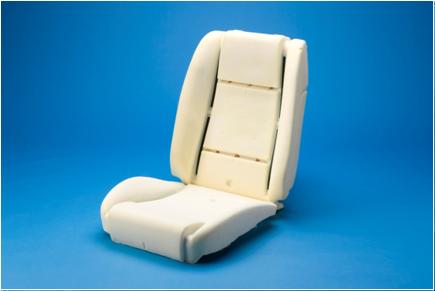
Cold cure moulded car seat cushions

Cold cure moulded car seat cushions

Flexible Foams with Enlarged Cell Size

Title: PUR FOAM WITH ENLARGED CELL STRUCTURE

 Number/Link: WO2014/170198 (German)

Applicant/Assignee: Evonik

Publication date: 23-10-2014

Gist”: The cell size of PU flexible foam is enlarged by using microcrystalline wax.

Why it is interesting: Enlarging the cell size of flexible foams can improve comfort properties by enhancing ‘breathabibility’, that is by enhancing airflow and moisture- and heat transport.  According to this invention the cell size of flex foams can be increased without affecting foam density or hardness by using a specific type of wax.  The wax (preferably) is a microcrystalline wax (as opposed to a paraffinic wax) with a congealing temperature of between 60 and 75°C.  The wax is used as a dispersion in a solvent (e.g. a sorbitan ester)  in an amount of about 0.05 to 2.0 php.

Cell structure of a flexible polyurethane foam.

Cell structure of a flexible polyurethane foam.

  • Pages

  • Categories

  • Enter your email address to follow this blog and receive notifications of new posts by email.

    Join 259 other subscribers
  • Follow Innovation in PU on Twitter