Prepregs from Glass Fiber and Reactive Polyurethane Powder

Title: PREPREGS AND MOLDINGS PRODUCED THEREFROM

 Number/Link: US2014065911

Applicant/Assignee: Evonik

Publication date: 6-03-2014

Gist”: A reactive polyurethane powder is prepared from a mixture of a  solid polyester polyol and a solid dimerised IPDI and subsequently used to make glass fiber prepregs.

Why it is interesting:  A polyurethane powder is made from (pref.) a mixture of  a solid (at room temperature) polyster polyol and a solid, blocked isocyanate.  The isocyanate is preferably an “internally” blocked IPDI.  Internally blocked meaning that the isocyanate contains uretidinedione groups.  The powder is scattered over a fibrous support and heated to over melting temperature but below curing temperature to make the prepreg.  Prepregs made with PU powder instead of the conventional resins have the advantage of being non-sticky, non-toxic and of having a very high storage stability (45 days in the examples).

Prepreg production with reactive PU powder
Prepreg production with reactive PU powder

Water Soluble Polyurethane “Star Polymers”

Title: MULTI-ARM HYDROPHILIC URETHANE POLYMERS, METHODS OF MAKING THEM, AND COMPOSITIONS AND PROCESSES EMPLOYING THEM

 Number/Link: US2014/038874

Applicant/Assignee: Stepan

Publication date: 6-02-2014

Gist”: PU star polymers, useful as surfactants, are prepared from a polyhydroxy ‘core’ molecule, a diisocyanate and a surplus of PEG.

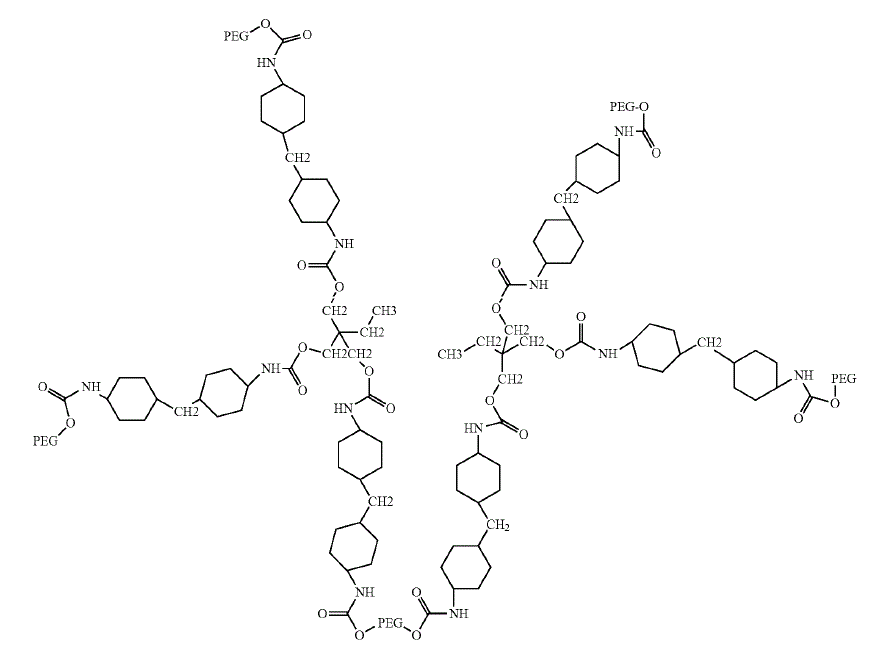
Why it is interesting: A low MW ‘core’ molecule with an OH functionality of up to 6 is reacted with a surplus of diisocyanate to form an NCO ended prepolymer. The prepolymer is then reacted with a suplus of a polyethylene glycol (PEG).  Reactants and ratios are chosen such that the average MW of the resulting product is less than about 10,000 and is water soluble or at least water dispersible. In an example trimethylolpropane is reacted with dicyclohexylmethane di-isocyanate (H12MDI) and ‘capped’ with PEG 400,  resulting in a mixture of structures, one of which is shown below.  The star polymers are supposedly useful as surfactants for use in detergents etc..
While these are interesting molecules, I doubt that these stuctures can be controlled finely enough to compete with established surfactants. I might be more interesting to use methoxy PEGs (i.e. monols) instead of PEGs.

Example of a PU star polymer.

Example of a PU star polymer.

Polyurethane Particles for Oil Absorption

Title: METHOD FOR PRODUCING POLYURETHANE PARTICLES

 Number/Link: US2013/0224376

Applicant/Assignee: Konishi Co.

Publication date: 29-08-2013

Gist”: A PU latex is prepared from an emulsion of an NCO-prepolymer in water which is crosslinked with a  triamine in the presence of hydrophilic silica particles. The latex is then spray dried to form oil absorbing particles.

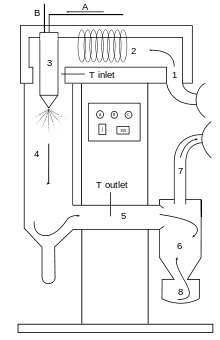
Why it is interesting: An NCO-ended IPDI-PTMEG prepolymer is dispersed in water an then crosslinked with a triamine.  To the resulting latex, hydrophilic silica particles are added and the composition is then sprayed into a high temperature atmosphere to evaporate the water and form the particles. The size of the silica particles is about 20 nm and a factor 30 smaller then the PU particles. The silica supposedly covers the PU particles so that they do not cohere and show good flow properties. The particles can be used to absorb natural  fats and oils (triglycerids)   Useful (I assume) in the pharmaceutical, cosmetic and agricultural industries (controlled release, perfumes, repellents..)

lab spraydryer schematic (Wikipedia)

lab spraydryer schematic (Wikipedia)

  • Pages

  • Categories

  • Enter your email address to follow this blog and receive notifications of new posts by email.

    Join 259 other subscribers
  • Follow Innovation in PU on Twitter