Thermal Engine Encapsulation with Polyurethane Foam

Title: THERMAL INSULATION OF AN INTERNAL COMBUSTION ENGINE

 Number/Link: WO2014/195153 (German)

Applicant/Assignee: BASF

Publication date: 11-12-2014

Gist”:  Engine parts are encapsulated in PU foam using moulds.

Why it is interesting: Encapsulating (part of) motor car engines with heat-insulating rigid PU foam is useful because it can reduce fuel consumption and exhaust. When the mass of the foam is increased (e.g. by filling with BaSO4) the encapsulation can also reduce noise levels. BASF has been working on this concept for more than 15 years now (see e.g. DE19935335) and the current application only relates to a process improvement:  an engine part is brought into a closed mould leaving a gap between part and mould which is then filled with PU foam. This is an interesting concept but I wonder if it is actually used in current motor cars.  And if not, why not?

Car with thermally encapsulated engine.

Car with thermally encapsulated engine.
 

Flexible Foams with Enlarged Cell Size

Title: PUR FOAM WITH ENLARGED CELL STRUCTURE

 Number/Link: WO2014/170198 (German)

Applicant/Assignee: Evonik

Publication date: 23-10-2014

Gist”: The cell size of PU flexible foam is enlarged by using microcrystalline wax.

Why it is interesting: Enlarging the cell size of flexible foams can improve comfort properties by enhancing ‘breathabibility’, that is by enhancing airflow and moisture- and heat transport.  According to this invention the cell size of flex foams can be increased without affecting foam density or hardness by using a specific type of wax.  The wax (preferably) is a microcrystalline wax (as opposed to a paraffinic wax) with a congealing temperature of between 60 and 75°C.  The wax is used as a dispersion in a solvent (e.g. a sorbitan ester)  in an amount of about 0.05 to 2.0 php.

Cell structure of a flexible polyurethane foam.

Cell structure of a flexible polyurethane foam.

Classic PU Patent of the Month: Scott Paper Co. on Reticulated Polyurethane Foams (1964)

Title: Reticulated polyurethane foams and process for their production

 Number/Link: US3171820

Applicant/Assignee: Scott Paper Co.

Publication date: 2-03-1965

Gist”: PU foams are reticulated by hydrolysis or explosion.

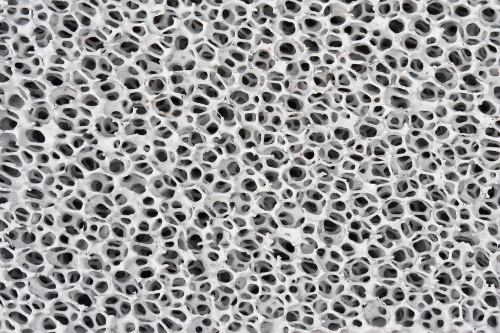
Why it is interesting:   Reticulated foams are foams from which the membranes have been removed so that only a three dimensional network of strands or ‘struts’ remains. These materials are commercially available in different grades of stiffness and porosity and are useful in applications such as filtering, sound absorbing, padding and the like. The current invention – filed in 1964 but a ‘continuation’ of an application filed in 1956- teaches the two processes to reticulate PU foam still in use today. The first process uses an aqueous NaOH solution to hydrolyse the cell membranes, in the second process a foam block is brought in an autoclave together with an explosive gas mixture (e.g. a mixture of oxigen and acetylene) which is then made to explode using a spark plug. When executed correctly the explosion removes all cell membranes leaving the struts intact. ‘Explosive recticulation’ is one of my all-time favorite PU inventions: simple, yet very effective and very courageous. In the current culture of hyper-safety where employees have to report paper-cuts, inventions like this are no longer possible.

Recticulate polyurethane foam

A recticulated polyurethane foam

  • Pages

  • Categories

  • Enter your email address to follow this blog and receive notifications of new posts by email.

    Join 259 other subscribers
  • Follow Innovation in PU on Twitter