Polyrotaxanes in Flexible Foams

Patent Title: POLYOL COMPOSITION FOR PRODUCING FLEXIBLE POLYURETHANE FOAM..

 Number/Link: US20160304689

Applicant/Assignee: Toyo Tire & Rubber

Publication date: 20-10-2016

Gist”: Polyrotaxanes in PU foam reduces ‘wobble’ when used in car seats

Why it is interesting: The use of polyrotaxanes in polyurethanes is not new and has been discussed before in this blog.  According to the current invention polyrotaxanes with OH-functional rings can be incorporated in flexible foams, where they are said to reduce tensile stress while having little impact on compressive properties. When these foams are used in (e.g.) vehicle seats that are subject to low frequency sideways vibrations, they should reduce the sense of “wobble” of the occupants. The theory is that under tension the rings slide along the axis molecule equalizing stresses. In the examples polyrotaxanes with 11000 to 20000 molecular weight PEG axis molecules are used with cyclodextrin rings having an OHv of 43 to 85.

Polyrotaxane-crosllinked polyurethane under stress (schematic)
Polyrotaxane-crosslinked polyurethane under stress (schematic)

Spray Foam with Increased Reactivity

Patent Title: POLYOL PREMIX COMPOSITION FOR RIGID POLYURETHANE FOAMS

 Number/Link: WO2016/162362

Applicant/Assignee: Covestro

Publication date: 13-10-2016

Gist”: Addition of dicarboxilic acid reduces cream time in amine catalyzed foams

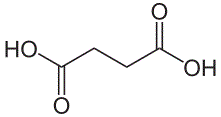
Why it is interesting: A short cream time has advantages for rigid PU spray foam because it can reduce dripping of the material after application.  According to this invention the cream time of an amine-catalyzed, HFC-blown spray foam composition can -surprisingly-be reduced by addition of a dicarboxilic acid, preferably succinic or glutaric acid. The diacids are used in a ratio of about 2 equivalents acid to 1 equivalent of (free) amine. In the examples a clear reduction of cream time is shown compared to compositions with no diacid, a mono-acid or less than the required amount of diacid. However, all examples also contain some trimerization catalyst (2-hydroxypropyl trimethylammonium formate) next to the tert-amine catalyst (N,N-dimethylcyclohexylamine). It would be interesting to see an example without the trimerization catalyst i.m.o.

Succinic acid.

Succinic acid


Self-Healing Polyurethane Coatings

Patent Title: Self-Repairing Polyurethane Networks

 Number/Link: US20160289495

Applicant/Assignee: Clemson University

Publication date: 6-10-2016

Gist”: Polyurethane networks with alkylated polysaccharide moiety show self-healing properties

Why it is interesting: Chitosan (pref.) is alkylated by reacting with dodecylaldehyde (in solvent) and reducing the resulting imine with sodium cyanoborohydride. The alkylated chitosan is then reacted with isocyanate and polyol.  When used as coating, the material is claimed to show self-healing properties when irradiated with UV light. Modifying the composition by incorporation of catechol, or by changing the saccharide allows for materials which ‘heal’ when exposed to ferric ions or carbon dioxide. No explanation for this behaviour is given and it is not immediately clear to me why this should work.

Self-healing network according to the invention. The isocyanate used was (E)-3,5-bis(6-isocyanatohexyl)- 6-( ( 6-isocyanatohexyl)imino )-1,3,5-oxadiazinane-2, 4-dione.

Self-healing network according to the invention. The isocyanate used was (E)-3,5-bis(6-isocyanatohexyl)-6-( ( 6-isocyanatohexyl)imino )-1,3,5-oxadiazinane-2,4-dione. ALK= alkyl, POL=polyol.


  • Pages

  • Categories

  • Enter your email address to follow this blog and receive notifications of new posts by email.

    Join 259 other subscribers
  • Follow Innovation in PU on Twitter