
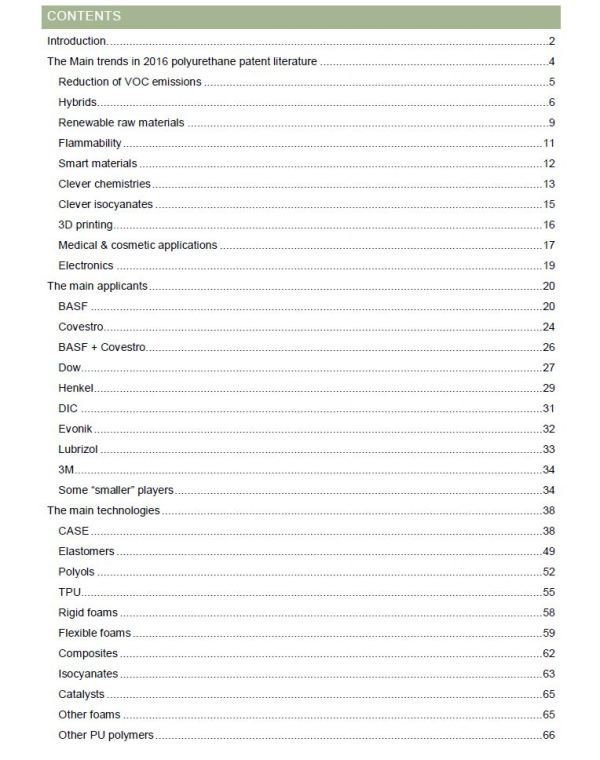
“Innovation in Polyurethanes 2016” : a 70-pages in-depth review of the main 2016 polyurethane patent literature is now available as pdf e-book.
To order: fill in the order form or contact me.
To order: fill in the order form or contact me.
Posted by Gerhard Bleys on February 27, 2017
https://purpatents.com/2017/02/27/now-available-innovation-in-polyurethanes-2016/
Patent Title: POLYURETHANE/UREA SILICON CARBIDE NANOCOMPOSITE
Number/Link: WO2017/027231
Applicant/Assignee: 3M
Publication date: 16-feb-2017
“Gist”: Surface modified SiC particles are dispersed in and covalently bound to a polyurethane matrix
Why it is interesting: Silicon carbide (carborundum) particles with an average particle size of about 500 nm are NCO-functionalized by reacting with a surface modfifying agent, e.g 2-triethoxysilylpropylisocyanate. The modified particles are then dispersed and covalently reacted into a polyurethane/polyurea matrix in an amount of 50-55% (w/w) on the composition. The composites can be made into highly erosion resistant films, for use on the outer surface of aircraft.

3-triethoxysilylpropylisocyanate
Posted by Gerhard Bleys on February 17, 2017
https://purpatents.com/2017/02/17/sic-pu-nanocomposites/
Patent Title: TELECHELIC PREPOLYMERS AND REACTION PRODUCTS THEREOF
Number/Link: WO 2017/023506
Applicant/Assignee: University of Minnesota
Publication date: 9-feb-2017
“Gist”: Diols are made by ROM polymerization of gem-dialkyl cyclooctene together with a symmetrical diol as chain transfer agent
Why it is interesting: According to this application, thermoplastic polyurethanes containing geminal dialkyl groups have far superior thermal stability, oxidative-, hydrolytic- and barrier properties as compared to TPUs containing conventional soft segments. Diols containing gem-dialkyl groups are prepared by ring-opening metathesis polymerization (ROMP) of a gem-dialkyl cyclooctene with a suitable catalyst and in the presence of a symmetrical aliphatic olefin chain transfer agent having functional end groups. Examples are 5,5-dimethylcyclooct-1-ene and 1,8-oct-4-ene diol as the chain transfer agent. The resulting diol is then reacted with (e.g.) 4.4′-MDI to prepare the TPU.
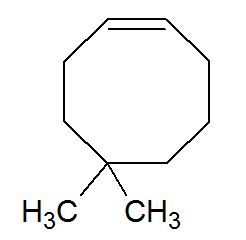
5,5-dimethylcyclooct-1-ene
Posted by Gerhard Bleys on February 10, 2017
https://purpatents.com/2017/02/10/tpu-from-gem-dialkyl-cyclooctadiene/
 Innovation in Polyurethanes