PU Rigid Foams from Biomass Proteins

Title: POLYOLS FROM BIOMASS AND POLYMERIC PRODUCTS PRODUCED THEREFROM

 Number/Link:WO2015/105542

Applicant/Assignee:  Inventors

Publication date: 16-07-2015

Gist”: Soy bean proteins are hydrolysed and reacted with diamines and cylocarbonates to produce “rigid” polyols.

Why it is interesting: During recent years a lot of research has been done on the use of renewable raw materials in polyurethanes.  Most of this research was on the use of natural oils despite the fact that the availability of biomass proteins is much higher. Soybeans for example contain about twice as much protein (about 38% w/w) than oil (18%) and the price is about half that of the oil. According to this invention soybean proteins are hydrolysed into amino acids which are then reacted with ethylene diamine to make amine-ended monomers.  These monomers are reacted with a cyclocarbonate (ethylene carbonate or glycerol carbonate) resulting in a mixture of hydroxyurethane oligomers. The mixture is a low viscous liquid with high hydroxyl value useful for the production of rigid foams.
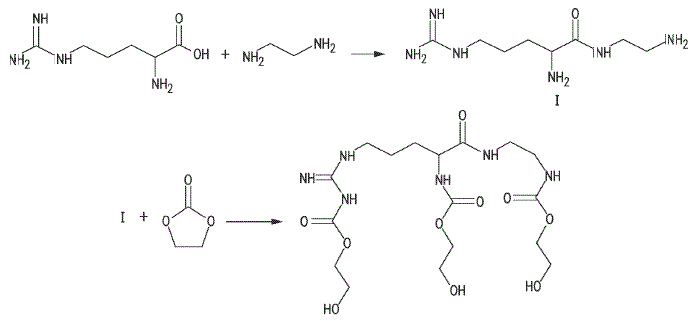
Reaction sequence according to the invention

Reaction sequence according to the invention

Polyurethane Rigid Foam Containing Lignin

Title: COMPOSITIONS OF PHENOLIC BIOPOLYMERS

 Number/Link:WO2015/055662

Applicant/Assignee: Solvay

Publication date: 23-04-2015

Gist”: Lignin is emulsified in a halogenated polyol and then used to prepare rigid foams.

Why it is interesting: This case is about yet another attempt to incorporate lignin into polyurethane materials. In this invention lignin is dispersed in a halogenated polyol using a suitable milling process. The polyol is preferably a brominated ‘rigid’ polyether.  The dispersed lignin (pref.) has a (d90) mean particle size of less than 100μm and is used in an amount of up to about 50% on the brominated polyether.  The lignin dispersion can then be used together with other polyols in rigid foam formulations.  The resulting foams should have improved flammability properties and the lignin is said to have no negative effect on thermal insulation properties.

Part of a typical lignin structure

Part of a typical lignin structure


Rigid Foams Containing Lignin

Title: PROCESS FOR THE PREPARATION OF LIGNIN BASED POLYURETHANE PRODUCTS

 Number/Link: WO2015/021541

Applicant/Assignee: Enerlab 2000

Publication date: 19-02-2015

Gist”: Dried lignin is mixed with isocyanate before being reacted with a rigid polyol and HFC blowing agent to make rigid foams

Why it is interesting: Lignin is a cheap and abundantly available hydroxy-functional biopolymer and it is no surprise that many attempts are being made to incorporate it into polyurethane materials. This case claims that lignins, dried to a moisture content of (preferably) less than 1% (0.5% in the examples), can be mixed with isocyanates to form a relatively stable mixture with a decent potlife. The mixture can then be used to make polyurethane materials.  In the examples HFC-blown rigid PU and PIR foams are shown containing about 20% of dried lignin and with densities ranging between about 30 to 40 kg/m³.  Interesting development, however claim 41, which states that elastomers and even TPUs can be made with mixtures, is clearly over the top in my opinion.

Part of a typical lignin structure

Part of a typical lignin structure

  • Pages

  • Categories

  • Enter your email address to follow this blog and receive notifications of new posts by email.

    Join 259 other subscribers
  • Follow Innovation in PU on Twitter