Polyamide Polymer Polyols

Patent Title: POLYAMIDE DISPERSION IN POLYOL AND PREPARATION THEREOF

 Number/Link: WO2017/216209

Applicant/Assignee:  BASF

Publication date: 21 December 2017

Gist”: Polyamide particles from polyether diamine and adipic acid are dispersed in polyol

Why it is interesting: Conventional polymer polyols contain either SAN-, polyurethane- or polyurea particles (see e.g. here).  According to this invention, polymer polyol dispersions can also be prepared by reacting a diamine, containing at least 50 wt% of a linear polyether having two terminal primary amine groups with a dicarboxylic acid (e.g. adipic acid) in a polyether polyol.  The reaction results in a dispersion of polyamide particles in the polyether polyol, stabilized by the polyether diamine. The polymer polyols are useful for flexible foam production and are said to show an improved hydrolysis resistance.

adipicacid

Adipic acid

Natural Oil Polyols using Self-Metathesis

Patent Title: POLYOLS FORMED FROM SELF-METATHESIZED NATURAL OILS AND THEIR USE IN MAKING POLYURETHANE FOAMS

 Number/Link: US2017/0291983

Applicant/Assignee:  Trent Univ.

Publication date: 12 october 2017

Gist”: NOPs from self-metathesized soy oils

Why it is interesting: The use of metathesis chemistry to modify natural oils before converting them to polyols has been discussed before in this blog:  see e.g. US2015/0337073, to the same applicant, which relates to cross-metathesis of natural oils using (e.g.) 1-butene. The current case is about self-metathesis of unsaturated natural oils, resulting in ‘metathesis oligomers’ which are then (partially) epoxidated and hydroxylated to prepare the polyols. In the examples soybean oil is turned into polyols with OH values between about 100 and 250, which are used to make flexible foams with densities of more than 150 kg/m³.

Oligomer from self-metathesis of unsaturated triglycerid


Monodisperse Polymer Polyol

Patent Title: PROCESS MAKING POLYMER POLYOL HAVING MONODISPERSE DISPERSED POLYMER PARTICLES

 Number/Link: WO2017/172417

Applicant/Assignee:  Dow

Publication date: 5 october 2017

Gist”: Polymer polyol with a “monodisperse” particle size distribution is prepared by using a specific seeding dispersion

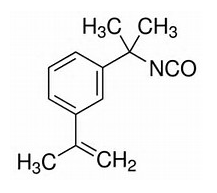
Why it is interesting: It is well known that the use of polymer polyols in flexible polyurethane foam formulations can result in improved airflow and load bearing properties. For optimal results the average particle size of the dispersed polymer needs to be similar to the cell wall thickness. According to this invention a SAN polymer polyol with a controlled and narrow particle size distribution can be prepared by using a seed dispersion which consists of an unsaturated macromer which, together with SAN particles of a particle size between 50 and 500 nm, is dispersed in a base polyol. The macromer is a PO/EO polyether with a (pref.) mole weight of 11000 to 14000 Da and having 4-5 OH groups and 1-2 reactive double bonds. The polymer polyol is prepared by dispersing the seed dispersion in the base polyol together with styrene, acrylonitrile and a solvent (e.g. isopropanol). After polymerization of the monomers the solvent is removed, resulting in a polymer polyol with at least 30% solids, average particle size of 1-3 μm and a size span of 1.25. In the examples the macromer is prepared by capping 1-2 OH groups of a 6-functional 90/10 PO/EO polyol with 3,3-isoprenyl-α,α-dimethylbenzylisocyanate.

3,3-isoprenyl-α,α-dimethylbenzylisocyanate


  • Pages

  • Categories

  • Enter your email address to follow this blog and receive notifications of new posts by email.

    Join 259 other subscribers
  • Follow Innovation in PU on Twitter