Hybrid PU-Peptide PUDs

Patent Title: AQUEOUS PEPTIDE-FUNCTIONALIZED POLYURETHANE DISPERSIONS

 Number/Link: WO2016/135162

Applicant/Assignee: Henkel; Max-Panck Ges.

Publication date: 1-09-2016

Gist”: A maleimide-capped prepolymer is reacted with the -SH groups in a peptide

Why it is interesting: Polyurethane-protein hybrids are interesting novel materials which potentially have a number of unique properties unattainable with conventional synthetic polymers. In a previous case discussed in this blog an NCO-ended polyurethane prepolymer was reacted with a peptide in water to make a PU-peptide dispersion.  This type of grafting, however, is not very specific because the isocyanate will react mostly with the free amino groups of lysine, which is usually  ‘abundant’ in a typical peptide. According to this invention the grafting can be made very specific by first end-capping the NCO prepolymer with maleimide groups and dispersing in water. The dispersion is then reacted with a peptide solution at pH7. In these circumstances the maleimide will react selectively with the free thiol group of cysteine, of which usually very few are present in a typical peptide because most thiol groups are engaged in S-S disulfide bridges.  Preferably a peptide consisting of 10-200 amino acids is used, with preferably only one free thiol group. By selective grafting the properties of the peptide can be conserved.  The PU-peptide dispersions are claimed to be especially useful for metal adhesives.
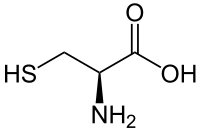
L-cysteine

L-cysteine


Polyurethane Elastomer with High Dielectric Constant

Patent Title: DIPOLE-MODIFIED POLYURETHANE, METHOD FOR PRODUCING SAME, AND USE THEREOF IN THE PRODUCTION OF CAST ELECTROACTIVE POLYURETHANE-BASED ELASTOMER FILMS

 Number/Link: WO2016102320  (German)

Applicant/Assignee: Covestro

Publication date: 30-06-2016

Gist”: A molecule with high dipole moment is incorparted in the PU backbone

Why it is interesting: According to this invention a polyurethane with an increased dielectric constant can be prepared by first reacting an isocyanate (f>2)with a hydroxyl-functional dipole.  This ‘dipole-modified’ isocyanate is then used in a (preferred) amount of 5-10% on the rest of the isocyanate of an elastomer formulation.  The dipole is of the form HO-R-D-X-A, where  D is an electron donor, A is an electron acceptor and X is a residue with a delocalized electron system.  In an example N-2-hydroxyethyl-N-methyl-4-nitroanilin is reacted with a biuret based on HDI to make the ‘dipole-modified’ isocyanate. Polyurethane elastomer films with high dielectric constant can be used as electromechanical transducers in sensors, actuators, artifical muscle etc..

N-2-Hydroxyethyl-N-Methyl-4-Nitroanilin

N-2-Hydroxyethyl-N-Methyl-4-Nitroanilin

+

TPU from Biorenewable Isocyanate

Patent Title: BIO-BASED DIISOCYANATE AND CHAIN EXTENDERS IN CRYSTALLINE SEGMENTED THERMOPLASTIC POLYESTER URETHANES

 Number/Link: WO2016041076

Applicant/Assignee: Trent University

Publication date: 24-03-2016

Gist”:  TPU with highly crystalline hard segment is based on 1,7 heptamethylenediisocyanate

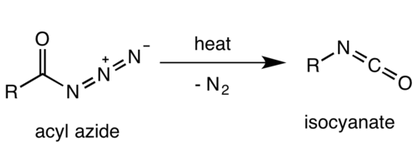
Why it is interesting: According to this application, polyester TPUs with crystalline hard segments can be produced using 1,7-heptamethylenediisocyanate. The HPMDI is reacted with a 2000MW poly(ethyleneadipate) diol and a short chain diol as chain extender. The  TPUs show a high hard-segment crystallinity, resulting in improved phase separation and in a (semi-)crystalline softphase which has a significant reinforcement effect. The TPUs are thermally stable up to 250°C and show a toughness and strength comparable to conventional TPUs. HPMDI can reportedly be made from natural oils using the Curtius rearrangement – but no reference is given.

Curtius Rearrangment

Curtius Rearrangment

  • Pages

  • Categories

  • Enter your email address to follow this blog and receive notifications of new posts by email.

    Join 259 other subscribers
  • Follow Innovation in PU on Twitter