Solid-Solid PU PCM

Patent Title: PHASE-CHANGE MATERIAL FOR STORING THERMAL ENERGY, MANUFACTURING METHOD AND USES OF SUCH A MATERIAL

 Number/Link:  WO2017/198933 (French)

Applicant/Assignee:  UNIV CERGY-PONTOIS

Publication date: 23 november 2017

Gist”: A crosslinked PEG-HMDI elastomer can be used as phase change material.

Why it is interesting: Phase change materials, used to dampen temperature cycles in buildings, are well known. Most organic phase change materials (e.g. paraffines) show solid-liquid phase transitions and therefore need to be macro- or micro-encapsulated. This invention is about polyurethane PCMs with a solid to solid phase transition, and therefore need not be encapsulated. The PU PCM is prepared by reacting a polyethylene glycol with a diisocyanate like HMDI together with a crosslinker like glycerol. The solid elastomer is then ground into powder which can be used in construction materials like plaster or cement. The transition temperature and the latent heat of the PCM is controlled through the mole weight of the PEG (e.g. 1000 to 2000 Da) and the degree of crosslinking.
Solid-solid PU PCMs are not new, see WO2011/089061 (Huntsman), which (in my opinion) presents a more elegant and flexible solution to the problem.

Phase_Change_Materials

Temperature damping by PCM (Wikimedia Commons)


Polythiourethanes for 3D Printing

Patent Title:  THIOURETHANE POLYMERS, METHOD OF SYNTHESIS THEREOF AND USE IN ADDITIVE MANUFACTURING TECHNOLOGIES

 Number/Link: WO2017/160810

Applicant/Assignee:  Univ. Texas

Publication date: 21-September-2017

Gist”: Photolatent bases are used to catalyse the polythiol-polyisocyanate reaction

Why it is interesting: According to this invention reactive systems useful for additive manufacturing processes can be prepared from polythiols, diisocyanates and a photolatent base.  When irradiated the photolatent base will split off a non-nucleophilic base which will catalyse the thiol-isocyanate reaction. The systems can be prepared such that the resulting materials show improved mechanical properties over current 3D printed materials.  In an example 2,2′-(ethylenedioxy)diethanethiol and pentaerithritol tetrakis(3-mercaptopropionate) are reacted with HDI using 1,1-dimethyl-1-(2-hydroxypropyl)amine-p-nitrobenzimide (DANBA) as a photolatent base.

Example of pholatent base (DANBA)

Hydrolysable Ureas

Patent Title: DYNAMIC UREA BONDS WITH FAST HYDROLYTIC KINETICS FOR POLYMERS

Number/Link: WO2017/155958

Applicant/Assignee: Univ. Illinois

Publication Date: 14 September 2017

“Gist”: Hindered urea bonds with fast hydrolysis kinetics are prepared from aromatic-sbstituted diamines and diisocyanates

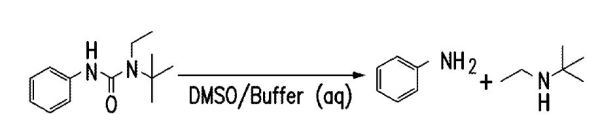
Why it is interesting: Polyurethanes containing thermally reversible hindered urea bonds (HUBs) have been discussed before in this blog. In the current case the HUBs are prepared from aromatic (e.g aryl-) substituted amines and are said to show fast, pH-independent, hydrolysis kinetics. The HUBs can be built into linear or crosslinked polyurethanes or other polymers like polyamides, polycarbonates etc.  The resulting materials are useful for medical applications like drug delivery, water-degradable packaging, self-healing materials and the like.

HUB hysdrolysis

Hydrolysis reaction of phenyl-N-tetrabutyl-N-ethyl urea


  • Pages

  • Categories

  • Enter your email address to follow this blog and receive notifications of new posts by email.

    Join 259 other subscribers
  • Follow Innovation in PU on Twitter