Dual-Cure PU for 3D Printing

Patent Title: POLYURETHANE RESINS HAVING MULTIPLE MECHANISMS OF HARDENING FOR USE IN PRODUCING THREE-DIMENSIONAL OBJECTS

 Number/Link: US2016137839

Applicant/Assignee: Carbon3D

Publication date: 19-05-2016

Gist”: Isocyanates are blocked with ethylenically unsaturated blocking agents

Why it is interesting: This invention relates to additive manufacturing of 3D objects using photocurable liquids. The liquid consists of a diisocyanate, or a difunctional isocyanate-ended prepolymer, which is blocked with an ethylenically unsaturated blocking agent, for example t-butylaminoethylmethacrylate (TBAEMA). The photocurable liquid further comprises a diol (or diamine), a photoinitiator and a ethylenically unsaturated diluent, for example a methacrylate or a styrene.  The liquid can then be selectively cured into an intermediate solid 3D object by irradiation with UV light using conventional “printing” methods. After an optional washing stage the intermediate object can be finally cured using heat.
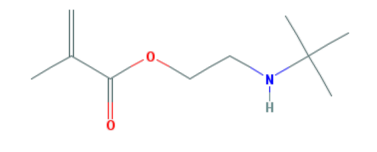
TBAEMA

TBAEMA

Thermoreversible Polyurea

Patent Title: DYNAMIC UREA BONDS FOR POLYMERS

 Number/Link: W02016/069582

Applicant/Assignee: University of Illinois

Publication date: 6-05-2016

Gist”: Urea bonds prepared from sterically hindered amines and isocyanates

Why it is interesting: The N-C bond in urea is very stable due to conjugation of the lone electron pair of the nitrogen atom with the cabonyl group.  According to this invention, the nitrogen atom can be subsituted with a strongly hindering group such that the coplanarity, and therefore most of the conjugation, of the C-N and C=O bonds is lost. These hindered urea bonds are much less stable and can reversibly depolymerize at relatively low temperatures. Thermoreversible bonds can be useful in a number of smart materials such as self-healing-, “4D printing”- , and reprogrammable shape memory materials. In an example a shape memory material with a Tg of 53°C and a Young’s Modulus of about 2 GPa was prepared by reacting 2-(t-buylamino)ethanol (TBAE) and trimerized hexamethylene diisocyanate (THDI). The ‘permanent shape’ of the material could be re-programmed by forcing the material in a new shape for 72 hours at 60°C.

Polurethane-urea with thermoreverisble urea bonds

Poly(urethane-urea) with thermoreverisble urea bonds

Classic PU Patent of the Month: ICI’s Perfect Elastomer (1995)

Patent Title: POLYURETHANE ELASTOMERS

 Number/Link: WO 97/21750

Applicant/Assignee: ICI

Publication date: 19-06-1997

Gist”: A polar polyether softblock and highly symmertrical hardblock results in a near-perfect polymer morphology.

Why it is interesting: ICI’s “perfect PU elastomer” is accomplished by reacting a polar, low-reactive polyether triol (75% EO random, 42 OHv) and a ‘stacking’ chain extender (MEG) with a symmetrical diisocyanate (4,4′ MDI).  Some water can be added to a density of about 400 kg/m³. This combination results in a remarkable polymer morphology with a ‘nano’ phase-separated hard domain and a very ‘clean’ soft phase, resulting in a very high (>1) and symmetrical damping peak (tan δ) and an incredibly flat storage modulus (E’) up to about 200°C.  Damping at positive temperatures  is virtually zero, resulting in a very high resilience.  The patent actually claims the shape of the DMTA trace rather than the composition of the polymer.
The elastomer is not completely “perfect” in that it has relatively low mechanical properties, such that it is perferably used in a structural- or fiber/particle reinforced composite.

1Hz DMTA trace of ICI's "perfect elastomer".

1Hz DMTA trace of ICI’s “perfect elastomer”.

  • Pages

  • Categories

  • Enter your email address to follow this blog and receive notifications of new posts by email.

    Join 259 other subscribers
  • Follow Innovation in PU on Twitter